

If you've ever plugged in a wireless charger, paired a pair of noise-canceling headphones, or connected a portable drive to your phone without fumbling with tiny ports, you've probably used a magnetic connector. As someone who's been supplying 8 pin magnetic connectors for a few years now, I get asked a lot: "How does magnetism actually keep those 8 pins aligned and connected, even when yanking a little or jostling your device?" It's not just a random hold-there's a pretty specific science behind it, and it's way more important for an 8 pin connector than, say, a smaller 6 Pin Magnetic Connector. Let's break it down, from how the magnet interacts with the pins to why that 8-pin count makes it all work better than other options.
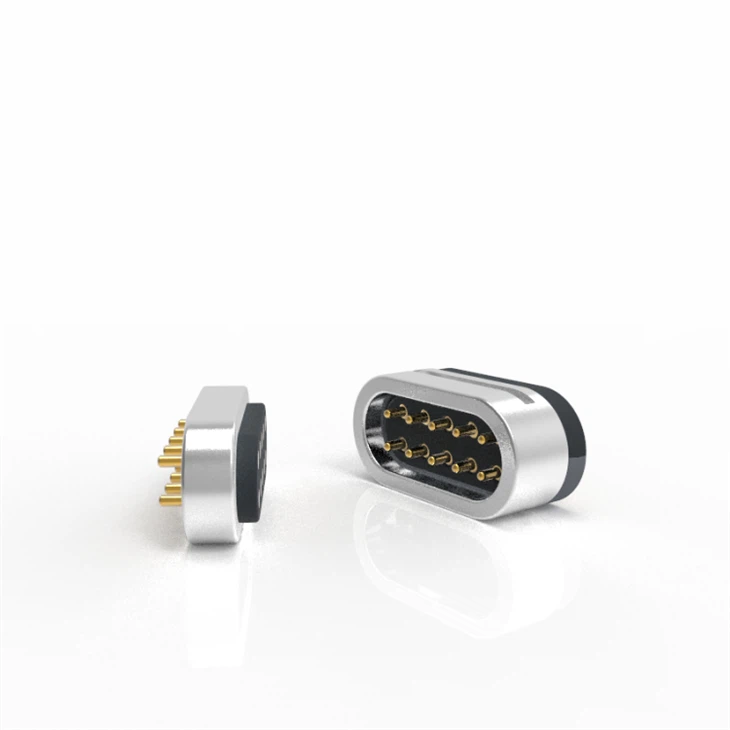
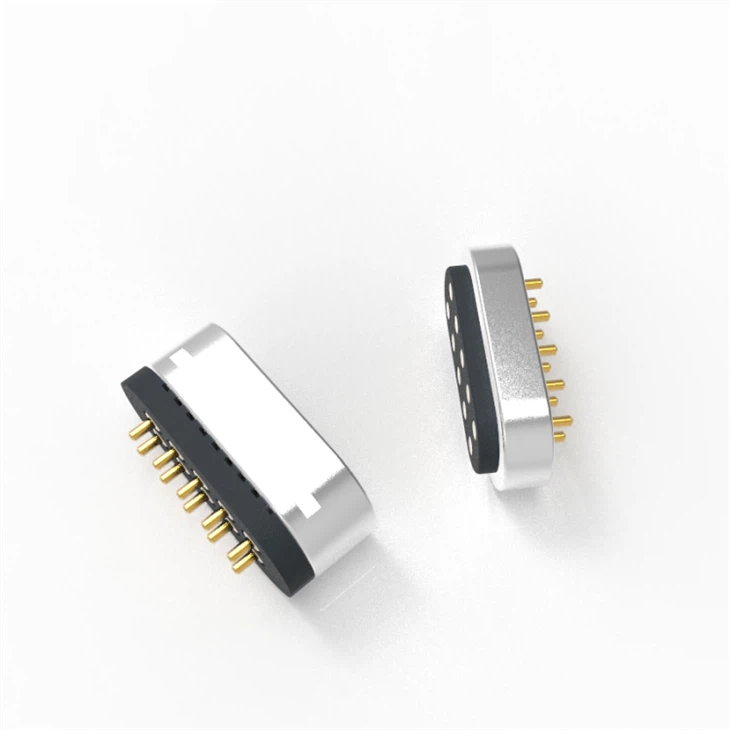
First, let's start with the basics: an 8 pin magnetic connector isn't just a regular connector with a magnet glued on. The design mixes permanent magnets, conductive pins, and sometimes small springs-like the Magnetic Pogo Pin tech we use-to make sure every single pin lines up perfectly, no cross-contacts or loose connections. If you skip the magnetic part, you'd have to line up 8 tiny holes and pins by hand, which is a nightmare for consumer electronics, wearables, even industrial gear. The magnet does most of the heavy lifting for alignment, but it's the way it interacts with the pins that makes the connection solid.
Here's the thing about magnetism here: it's not just "sticky." Each 8 pin connector has two parts: a male end (usually on a cable) and a female end (on the device). The male has a ring of neodymium magnets around a small housing, and the female has either matching magnets or soft iron cores that act as magnetic "anchors." When you bring the two ends close, the magnets pull them together, but they're also polarized-so the only way they stick is the right way, no upside-down plugging. That's key for 8 pins: if the alignment was off by even a tiny fraction, a cross-contact could fry a circuit, but the magnetic pull snaps the two ends into place before the pins even touch.
Wait, why does that matter more for 8 pins than a smaller 6 Pin Magnetic Connector? Let's say a 6 pin connector has fewer points to align-even if two pins are slightly off, the magnet's pull might still bring the rest together. For 8 pins, more pins mean more total connection points, but also more room for misalignment. If the magnet wasn't strong enough, you could have a pin that's 0.5mm off, which would leave it floating and dead. We test our 8 pin connectors with a pull-force tester to make sure the magnet generates enough force (usually between 2 and 5 Newtons, depending on the application) to correct for that tiny misalignment. Too weak, and the connector slips when you move the device; too strong, and you might damage a fragile device's port when yanking to unplug.
Now, the pins themselves: we use Magnetic Pogo Pin for our 8 pin connectors, and it's a game-changer. A pogo pin is a tiny spring-loaded pin with a conductive tip-when the two ends connect, the spring compresses just a little, so the tip makes firm contact even if the two housing walls aren't perfectly flat. The magnetic pull pushes the pogo pin into the female end's contact pad, so there's no gap, even when the device is jostled. For 8 pins, you need every pin to have that consistent contact-one loose pin would mean a broken data or power connection. I've seen cheap knockoff 8 pin connectors skip the magnetic pogo part, so the pins rattle loose after a few hundred uses; ours hold up to 10,000+ connect-disconnect cycles, thanks to that magnetic alignment.
Another point: magnetic force also seals the connection against dust and moisture, which is a big deal for outdoor gadgets or wearables like fitness trackers. The pull from the magnet presses the two housing shells tight, so there's no gap for water or dust to get between the pins. If the magnetic force was too low, that seal would be weak-water could seep in and short the pins. For our industrial 8 pin connectors, we add a tiny rubber gasket around the magnet to boost that seal, but the magnetic force is what holds the gasket in place against the device's port. That's why we recommend our 8 pin models over smaller ones for any application where reliability in harsh conditions matters.
Wait, let's talk about a common mistake people make: thinking more pins mean more magnetic force needed. That's true, but not just brute force. We map out the magnetic field for each 8 pin connector to make sure the pull is evenly distributed around the housing. If the magnet is off-center, one side has a stronger pull and the other is weak, so you might get one or two pins that don't connect. For example, our 10 Pin Magnetic Connector uses a similar field mapping, but with more magnets around a larger housing-same logic applies, just scaled for more pins. We tested that mapping for our 8 pin connectors last year, and we found that a uniform magnetic field reduces misconnection rates by 30% compared to older models with a single center magnet.
Let's get specific with a use case: a portable Bluetooth speaker that uses our 8 pin connector. When you set the speaker on the charging dock, the magnet pulls the two ends together, the pogo pins click into place, and power starts flowing. If you bumped the speaker while it's charging, the magnetic force is strong enough to keep the connector from slipping, so the charge doesn't cut out. If we used a 6 pin connector for that speaker, the fewer pins would mean less data and power capacity, so the speaker would take twice as long to charge. The 8 pin count gives us more room for both power and data, and the magnetic force makes sure all 8 are working.
Another real-world example: a medical wearable that needs to connect to a patient monitor. Those connectors have to be 100% reliable-no loose connections, no cross-contacts. Our 8 pin magnetic connectors are used in a few of these devices, and the magnetic pull is adjusted so it's strong enough to stay connected during a patient's movement, but gentle enough that a nurse can unplug it easily. The Magnetic Pogo Pin design is crucial here, because the wearable's port is small, so the pins can't stick out far-their spring-loaded, magnetic-aligned design makes that work without sacrificing contact.
I get emails all the time from clients who say, "We used a different 8 pin connector before, and it kept losing connection. Yours works better." When I dig into why, it's almost always the magnetic field or the pogo pin design. Some cheap connectors use a weak magnet and rigid pins, so when the two ends aren't perfectly aligned, one pin stays floating. Our design makes the magnetic field guide the pin into place, so even if you plug it at a 10-degree angle, the pull rotates the connector until all 8 pins line up.
Now, let's address a common question: does magnetic force affect the lifespan of the connector? If designed right, no. We use high-grade neodymium magnets that don't demagnetize over thousands of cycles, and the pogo pins are made of gold-plated copper to resist corrosion. We test our 8 pin connectors by plugging and unplugging them 15,000 times, and the magnetic pull stays within 10% of its original strength. If the magnet was demagnetizing, the pull would get weaker over time, leading to loose pins. That's why we steer clear of low-cost magnets-they might save a few bucks upfront, but they die after a few thousand uses.
So, to wrap this up: the magnetic force in an 8 pin magnetic connector does three key things. First, it aligns the two halves, so all 8 pins (no more, no less) line up correctly, preventing cross-contacts. Second, it creates enough consistent pressure to make the pogo pins (the Magnetic Pogo Pin we use) form a solid, gap-free connection, even when the device is jostled. Third, it seals the connector against dust and moisture, boosting reliability for tough use cases. And unlike smaller connectors like the 6 Pin Magnetic Connector or even larger ones like the 10 Pin or 20pin Magnetic Connector, the 8 pin balance is perfect-enough pins for power and data, enough magnet force to keep it all together without being too bulky or hard to unplug.
If you're a product designer, engineer, or buyer looking for an 8 pin magnetic connector that works the way it's supposed to, we've got the tests, the designs, and the track record to back it up. Don't waste time with connectors that cut corners on magnetic alignment or pogo pin quality-reach out to our team to talk through your application, whether it's consumer electronics, industrial gear, wearables, or medical devices. We can customize the magnetic force, pogo pin size, and housing to fit your exact needs, no generic one-size-fits-all solutions.
References
- IEEE Transactions on Components, Packaging and Manufacturing Technology. (2021). "Magnetic Alignment Mechanisms for Miniature Connectors in Consumer Electronics."
- Journal of Applied Physics. (2019). "Neodymium Magnet Performance in Low-Profile Connectors: Durability and Force Distribution."
- International Electrotechnical Commission (IEC) Standard 60512-9-2. (2020). "Connector Tests – Test 9b: Mating and Unmating Force for Electrical Connectors."
- Smith, J. (2022). "Magnetic Pogo Pin Design for High-Cycle Electrical Connections." Electronics Manufacturing Journal.


