

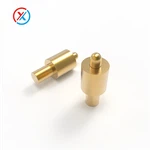


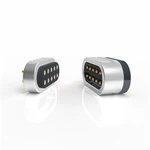
Lens Connector
Your Professional Lens Connector Supplier
Dongguan Xinteng Electronics Co., Ltd. is a leading high-reliability Pogo Pin connector solution provider in China, integrating R&D, production and sales.
The main solutions include: Lens connector solutions,Pogo pin connector solutions, magnetic connector solutions, pogo pin cable solutions, precision accessories, etc.
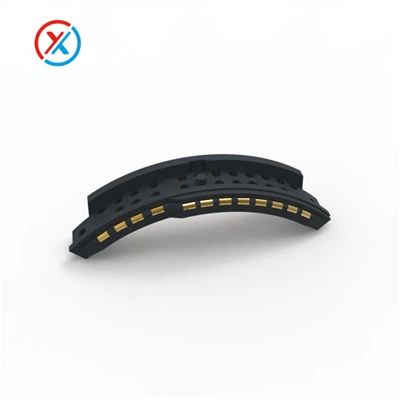

Parameter
| Product model | RT-1118 |
| Rated voltage | DC 12V |
| Rated voltage | 1 A Max |
| Contact resistance of spring pin | 50 milliohm Max |
| Temperature tolerance | 260℃ |
| 0peration Temperature | -25℃ to +80℃ |
| Salt Spray | 24H |

Manufacturers offer lens connector in a variety of configurations, including different pin lengths, Connector size, number of pins, and contact plating options such as gold or nickel.
Camera lens connector advantages
Compact and Space-Saving
Camera lens modules often have limited space. Our camera lens connector features a miniaturized design, enabling multi-channel signal and power transmission within this limited space.
Stable Signal Transmission
The high-quality gold-plated contact design ensures strong signal integrity and excellent anti-interference performance, ensuring stable transmission even in weak signal environments. The contact resistance is less than 50 milliohms.
High durability and long life
Using gold-plated turning pins or corrosion-resistant metal parts, the mechanical lifespan typically reaches over 50,000 insertion and removal cycles. It is heat-resistant up to 260°C and has passed a 24-hour salt spray test without oxidation.
Improves overall reliability and brand image
Using a dedicated lens connector not only enhances the camera's structural professionalism but also creates a cleaner, more uniform appearance. For example, in high-end industrial, security, automotive, or intelligent imaging applications, customizing the camera lens connector has become a key detail that reflects a brand's craftsmanship and quality.
Highly Customizable
Camera lens connectors are typically non-standard components. We can customize lens connectors based on the customer's device structure, pin count, electrical specifications, waterproof rating, and assembly method.
Our Service
We are looking for a cooperative partner to expand our business.
Pre-sales service
24-hour online, providing one-stop solution service based on customer demand analysis and solutions.
In-sales
Fully automatic + manual double inspection of shipment, on-time delivery, quality assurance.
After-sales
Providing technical support services and product installation consulting services.
Additional Information
Shipping
We offer various shipping methods, including sea freight, air freight, and express delivery, depending on the order size and destination.
Terms Of Payment
We usually accept T/T, L/C, Paypal, Credit card, etc. If you prefer other payments terms, please feel free to discuss with us.
FAQ
Q: What should be done about connector height restrictions due to the limited space within the lens module?
A: This is a common problem with cameras. Typically, a low-profile connector structure is custom-designed, and a flat design is also possible. If necessary, the connector can be "embedded" within the housing, allowing the pins to slightly protrude for contact, thus reducing the overall thickness.
Q: If the gold plating is too thin, will it cause poor contact after six months of use?
A: Camera signal cables carry low current, but require stable contact. If the plating is too thin, it can easily wear through and oxidize. As a rule of thumb, we prefer a thick gold top layer with a nickel base layer to ensure long-term stability.
Q: Will the high temperature during lens module soldering cause the connector to deform?
A: Whether this will cause connector deformation depends on the plastic material. If standard P-plastic is not heat-resistant enough, we recommend choosing a high-temperature-resistant material that can withstand 260°C reflow soldering.
Q: Is there interference or noise in the lens signal cable transmission?
A: This indicates poor shield grounding or an improper pin layout. High-speed signals are best arranged using a differential layout, with an outer shielding shell or nickel-plated cover. When debugging MIPI signals, image noise is immediately noticeable if the shielding is not properly connected.
Q: Can we customize camera lens connectors?
A: Of course, we can customize a connector based on your camera's specifications. We can tailor the size, lifespan, performance, and other aspects to meet your specific needs.