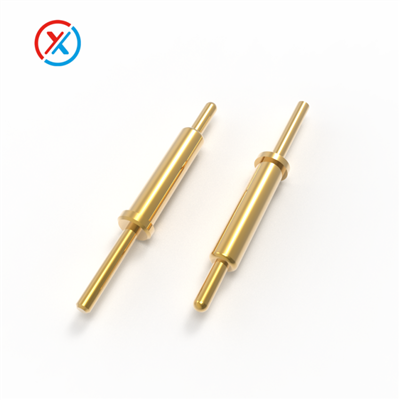
In the realm of electronic connectors, the Connecteur Pogo Pin stands out as a crucial component, known for its versatility and reliability. As a leading supplier of Connecteur Pogo Pin, I am often asked about various technical aspects of these connectors, and one question that frequently arises is: "What is the capacitance of a Connecteur Pogo Pin?"
Understanding Capacitance in General
Before delving into the capacitance of a Connecteur Pogo Pin, it's essential to understand what capacitance is. Capacitance is the ability of a component to store an electrical charge. It is measured in farads (F), although in practical applications, microfarads (μF), nanofarads (nF), and picofarads (pF) are more commonly used. Capacitance occurs when two conductive surfaces are separated by an insulating material, known as a dielectric. The amount of charge a capacitor can store depends on the surface area of the conductors, the distance between them, and the dielectric constant of the insulating material.


Capacitance of a Connecteur Pogo Pin
A Connecteur Pogo Pin is a spring-loaded connector that consists of a plunger, a barrel, and a spring. When considering its capacitance, several factors come into play.
Geometric Factors
The physical dimensions of the Connecteur Pogo Pin significantly influence its capacitance. The surface area of the plunger and the barrel, as well as the distance between them, are key geometric factors. A larger surface area of the conductive parts increases the capacitance, as there is more space for the charge to accumulate. Conversely, a greater distance between the plunger and the barrel reduces the capacitance, as the electric field between them is weaker.
For example, if we have two Connecteur Pogo Pins with different plunger diameters, the one with the larger diameter will have a higher capacitance, assuming all other factors remain constant. This is because the larger plunger provides a greater surface area for the charge to be stored.
Dielectric Material
The dielectric material between the plunger and the barrel also affects the capacitance. In most Connecteur Pogo Pins, air acts as the dielectric. However, in some cases, a specific insulating material may be used to enhance the performance or provide additional protection. The dielectric constant of the material determines how much the capacitance is increased compared to using air as the dielectric. A material with a higher dielectric constant will result in a higher capacitance.
Frequency and Signal Characteristics
The capacitance of a Connecteur Pogo Pin can also vary with the frequency of the electrical signal passing through it. At higher frequencies, the capacitance may have a more significant impact on the signal integrity. This is because the capacitive reactance, which is inversely proportional to the frequency and capacitance, can cause signal attenuation and distortion.
Measuring the Capacitance of a Connecteur Pogo Pin
Measuring the capacitance of a Connecteur Pogo Pin requires specialized equipment. A capacitance meter or an impedance analyzer can be used to accurately measure the capacitance. These devices apply a known voltage to the connector and measure the resulting charge or impedance.
It's important to note that the measured capacitance may vary depending on the measurement setup. Factors such as the test fixture, the connection method, and the environmental conditions can all affect the measurement results. Therefore, it's crucial to follow a standardized measurement procedure to ensure accurate and reproducible results.
Importance of Capacitance in Connecteur Pogo Pin Applications
The capacitance of a Connecteur Pogo Pin plays a vital role in its performance in various applications.
Signal Transmission
In high-speed data transmission applications, such as in mobile devices or computer systems, the capacitance of the Connecteur Pogo Pin can affect the signal quality. A high capacitance can cause signal delay, attenuation, and crosstalk, which can lead to data errors and reduced performance. Therefore, it's important to choose a Connecteur Pogo Pin with an appropriate capacitance for the specific application.
Power Delivery
In power delivery applications, the capacitance of the Connecteur Pogo Pin can impact the efficiency and stability of the power transfer. A high capacitance can cause a larger inrush current when the power is turned on, which can damage the components or cause voltage drops. On the other hand, a low capacitance may not be able to store enough charge to provide a stable power supply.
Our Offerings as a Connecteur Pogo Pin Supplier
As a trusted Spring Loaded Pogo Pin Connector and Spring Loaded Pin Connector supplier, we understand the importance of capacitance in the performance of our products. We offer a wide range of Connecteur Pogo Pins with different capacitance values to meet the diverse needs of our customers.
Our engineering team works closely with customers to understand their specific requirements and recommend the most suitable Connecteur Pogo Pin for their applications. We use advanced manufacturing techniques and high-quality materials to ensure the reliability and performance of our products.
Conclusion
In conclusion, the capacitance of a Connecteur Pogo Pin is a critical parameter that affects its performance in various applications. Understanding the factors that influence the capacitance and measuring it accurately are essential for ensuring the optimal performance of the connector. As a leading supplier of Connecteur Pogo Pins, we are committed to providing high-quality products with the right capacitance for your specific needs.
If you are interested in learning more about our Connecteur Pogo Pins or have any questions regarding their capacitance or other technical aspects, please feel free to contact us. We look forward to discussing your requirements and finding the best solution for your application.
References
- "Fundamentals of Electric Circuits" by Charles K. Alexander and Matthew N. O. Sadiku
- "Electronic Connector Handbook" by Ronald B. Standley