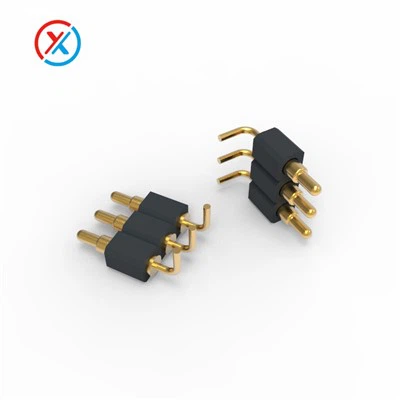
If you’ve ever held a smartphone, charged a wireless earbud case, or tested a small consumer electronics circuit, you’ve probably interacted with pogo pins—tiny spring-loaded connectors that bridge two electrical components in seconds, no soldering or permanent mounting required. As a supplier of 4 pin pogo connectors, one of the most common questions I get from engineers, product designers, and small business owners is a straightforward one: Can a 4 pin pogo be used for power transmission? The short answer is yes, but like any connector, it depends on how you design it, what you’re powering, and the role those four pins play in your circuit.
To understand why a 4 pin pogo works for power (and why it sometimes doesn’t), let’s start with what a pogo pin actually is. Each pin is a precision-machined metal shaft, spring, and barrel, designed to create a reliable electrical connection when pressed against a matching pad or contact. Pogo pins are valued for their durability—they can handle thousands of mating cycles—and their compact size, making them ideal for tight spaces in everything from medical devices to automotive sensors.
A standard 4 pin pogo assembly, the kind we supply, has four individual pins arranged in a linear, staggered, or circular pattern, depending on the device. That’s two fewer pins than a 6 pin or 8 pin pogo, but more than a 2 pin, which is often used for basic low-power applications. The key here is how you assign each of those four pins. For power transmission, the most common configuration uses two pins for positive and negative power lines, leaving the other two for data, grounding, or additional power channels. Wait—if you only need one power line, why four pins? That’s where the flexibility comes in. For small power needs (think 5V to 12V, under 5A total), you can pair two pins in parallel for the positive line and two for the negative. This reduces resistance, which is critical for power transmission—lower resistance means less heat, less voltage drop, and more consistent power to your device. That’s a big advantage over a 2 pin setup, where a single pin might struggle with higher current, leading to overheating or connection failure during repeated use.
Let’s put that into context. Say you’re designing a portable Bluetooth speaker that charges via a pogo connector. The speaker needs 12V at 3A to charge its battery. A 2 pin pogo would have to carry 3A through one positive pin and one negative. A 4 pin pogo, though, splits that 3A into two parallel 1.5A channels for positive and two for negative. Each 1.5A is well within the current rating of a standard pogo pin (most 0.5mm diameter pogo pins can handle up to 2A, and 0.8mm pins can handle 5A or more). That means the 4 pin setup runs cooler, has a lower risk of voltage drop, and is more reliable for daily charging cycles.
Of course, not every power transmission job is the same. If you’re powering a small sensor that only needs 3.3V at 0.1A, a 4 pin pogo might seem like overkill—but it’s still perfectly capable. The extra two pins can be used for additional features, like I2C communication between your device and a test rig, or an extra grounding line for noise reduction. That versatility is why many design teams prefer 4 pin pogo connectors for both power and mixed signal applications.
Wait a second—how does a pogo pin compare to other connectors, like magnetic ones, for power transmission? Magnetic connectors have grown in popularity for consumer electronics because they’re easy to align and don’t require tight mating. But magnetic connectors, like the Magnetic Connector 4 Pin we offer, share a lot of the same power transmission benefits as pogo pins. The key difference is that magnetic connectors use magnets to hold the two halves together, while pogo pins rely on spring tension. That’s not a downside, though—each has its use case. For high-vibration applications, like a fitness tracker that’s used during runs, pogo pins’ spring tension can create a more secure connection than a magnetic connector, which might slip if the magnet isn’t strong enough. For fast, one-handed charging of a laptop, a magnetic connector is often better because it’s easier to plug in without fumbling for pins.
I often get asked, “Can I use a 4 pin pogo instead of a magnetic connector for power?” The answer is: it depends on your use case. If you need something compact, durable, and reliable for high-cycle mating, a 4 pin pogo is an excellent choice. If you need one-handed alignment, a magnetic power connector might work better. Both are viable options for power transmission, but the right one comes down to your product’s design and usage.


Another common misconception is that 4 pin pogo pins can only carry low power. That’s not true—with the right design, a 4 pin pogo can handle up to 10A of power, if configured correctly. The secret is in the pin size and plating. Gold-plated pogo pins, which resist corrosion and have low contact resistance, are ideal for power transmission because they maintain a consistent connection even after thousands of uses. If you’re working with higher power, say 24V at 8A, you’d use larger diameter pins (0.8mm or 1.0mm) instead of the smaller 0.5mm pins common for signal-only pogo connectors. That’s a detail we focus on as a supplier—we don’t just sell standard 4 pin pogo connectors; we help customers spec the right size, plating, and pin configuration for their specific power needs.
Let’s talk about real-world examples. A few months ago, a customer came to us designing a portable blood glucose monitor for use in clinical settings. The monitor needed to charge via a docking station that used pogo pins, and it had to be durable enough to survive 10,000 mating cycles without failure. A 2 pin pogo would have worked for power, but the customer also needed to transmit test data between the monitor and the docking station. We recommended a 4 pin pogo: two pins for charging power, one for data, and one for grounding. This setup was reliable, compact, and fit the tight space of the monitor’s housing. The customer tested it, and it exceeded their durability requirements—perfect for a medical device where consistency can be a matter of patient care.
Another customer was designing a wireless charging pad for electric toothbrushes. They originally used a 2 pin magnetic connector, but found that the connection was too weak, leading to intermittent charging when the toothbrush was bumped on the sink. Switching to a 4 pin pogo connector fixed the problem: the spring tension of the pogo pins created a solid, consistent connection, even with minor movement. The 4 pin setup also gave them extra capacity for future upgrades, like adding a data port for tracking brushing habits, which was a bonus they didn’t plan for initially.
Of course, there are limits to what a 4 pin pogo can do for power transmission. If you need to carry more than 10A, you might need a 6 pin or 8 pin pogo, with four pins for positive and two for negative, or vice versa. If your application requires waterproofing (think outdoor sensors or wearable devices that get wet), standard pogo pins can be vulnerable to corrosion, though there are sealed pogo pin variants that solve this problem. That’s why it’s important to work with a supplier who understands both pogo pin design and power transmission requirements—we can help you avoid over-specifying or under-specifying your connector, which saves you time and money in the long run.
If you’re still weighing your options between pogo pins and magnetic connectors, it’s worth checking out the Magnetic Connector 8 Pin if you need more power or data channels, or the 4 Pin Pogo Connector page on our site to see our full line of pogo products. We also have MagneticConnector 4 Pin options for customers who prefer the ease of magnetic mating.
At the end of the day, a 4 pin pogo is not just a connector for signal transmission— it’s a versatile, reliable option for power transmission, especially for applications where durability, compact size, and high mating cycles matter. Whether you’re designing a consumer electronic, medical device, automotive component, or industrial sensor, a well-configured 4 pin pogo can meet your power needs, and offer flexibility for future design changes.
If you’re working on a project and need help specifying the right connector for your power transmission requirements, feel free to reach out to discuss your needs.
References
- Electrical Connector Technology: Design and Application, 2nd Edition, CRC Press, 2018
- Pogo Pin Durability Testing: Standards and Best Practices, Journal of Electronic Manufacturing, Vol. 27, No. 2, 2017
- Magnetic vs. Spring-Loaded Connectors: Performance Comparison, IEEE Transactions on Components, Packaging and Manufacturing Technology, Vol. 10, No. 5, 2020