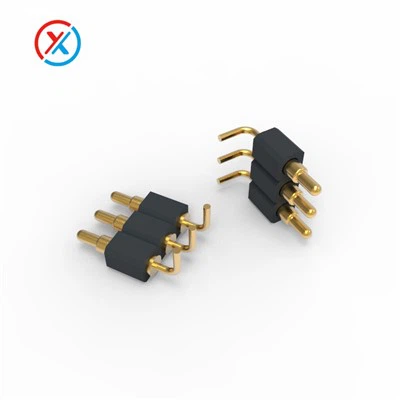
When you’re sourcing pogopins for electronic assembly, it’s easy to fixate on specs like spring tension, current rating, or durability cycle count—those numbers that jump off a product sheet. But if you’ve ever walked a manufacturing floor or troubleshooted a batch of failed PCBs, you know the tiny, often-overlooked detail that often makes or breaks performance: the tip shape of the pogo pin. As a pogopin supplier who’s worked with engineers from automotive, consumer electronics, and medical device industries over the past decade, I’ve seen firsthand how a subtle change to tip geometry can shift a part from “great” to “problematic.”
To start, let’s ground this in what a pogopin actually does: it’s a spring-loaded contact pin that creates a temporary or permanent electrical connection between two components—think a battery terminal in a wireless headphone, a test point on a PCB during manufacturing, or a charging connector for a smart watch. The tip is the interface between the pin and the mating surface (whether that’s a solder pad, a spring terminal, or another pogopin). Its shape determines how it seats, distributes force, resists wear, and even avoids damage to the parts it touches.
Let’s break down the most common tip shapes and how they perform in real-world scenarios, with examples from projects our team has supported. The first and most widely used is the convex (or domed) tip. This is the go-to for most standard applications, and it’s the design you’ll find in most Spring Pogo Pins and Pogo Contact Pins we manufacture. The rounded dome distributes contact force evenly across the mating surface, which reduces the risk of scratching or denting fragile pads—critical for low-profile PCBs common in smartphones and wearables. For test and measurement applications, the convex tip excels because it self-aligns slightly as it makes contact. If the mating surface is slightly off-center or has minor surface imperfections, the rounded shape will “roll” into place to create a consistent connection, rather than bouncing or misaligning. We once worked with a medical device maker that switched from flat tips to convex domes for their internal test probes; they cut contact failure rates in half, because the domed tip didn’t catch on the edge of thin solder pads that were prone to lifting during assembly.
But convex tips aren’t perfect. In applications that require high current, like power transfer for wireless charging or industrial connectors, the wide surface area of a domed tip can actually be a downside. A larger contact area means more points of potential resistance, especially if the mating surface has oxidation or grime. Enter the conical (or pointed) tip. This sharp, tapered shape concentrates force into a tiny point, creating a deep, clean indentation in the mating surface. That penetration breaks through surface oxide layers, which is why conical tips are often used in high-reliability applications where corrosion is a risk—like outdoor sensors or automotive components that operate in extreme temperatures. We’ve designed custom 1.0 Pogo Pin Contacts with conical tips for an automotive client’s battery management system, where the pins have to resist salt spray and temperature swings from -40°C to 125°C. The pointed tip pierces through thin oxide layers that would cause a convex tip to lose connection, even after 10,000 actuation cycles. The tradeoff here is wear: the sharp point will wear down faster than a domed tip if it’s repeatedly pressed into hard materials like nickel or gold plating, so it’s not ideal for applications with millions of actuation cycles.
Another common tip shape is the flat, or butt, tip. This is the simplest design, a straight, flat end on the pin, and it’s used for applications where two pins need to mate directly, like double-ended pogopins that connect two PCBs side by side. Flat tips create a large, stable contact surface, which makes them great for high-current applications that need consistent power transfer—like fast-charging docks for laptops or power tools. The downside is that flat tips require precise alignment; if the mating surface is even slightly off, the edge of the flat tip can skip or fail to make full contact. We had a client who tried to use flat tips for a consumer drone’s charging connector, and they had a 30% failure rate because the drone’s charging port could shift 0.2mm during docking, enough to break the line contact between the flat tip and the port pad. Once they switched to a domed tip, that failure rate dropped to under 1%.
Then there’s the chamfered tip, a hybrid shape that’s a flat end with a beveled edge around the perimeter. Chamfered tips balance the alignment ease of domed tips with the penetration of conical tips, which makes them a popular choice for soldering applications. Wait, soldering? When we talk about pogopin tips, we don’t just mean the mating end—we also mean the end that attaches to the PCB. That’s why you’ll find detailed guides on Pogo Pin Soldering for different tip designs. For example, a chamfered tip on the solder end creates a larger surface area for solder to adhere to, which reduces the risk of cold joints—an issue where the solder doesn’t properly bond to the pin, leading to intermittent connections. We also often get requests for right angle pogopins with chamfered tips for compact devices where space is tight; the beveled edge makes it easier to align the pin with the PCB’s solder pad during manual or automated assembly, cutting down on time per unit.
Beyond these common shapes, there are custom designs tailored to specific needs. For example, notched tips for high-vibration applications, where a domed tip might slip loose, or rounded flat tips for fragile glass surfaces in wearables, where a conical tip would scratch the glass. The key takeaway here is that tip shape isn’t a cosmetic detail—it’s a core performance driver that ties into every part of a pogopin’s lifecycle, from assembly to long-term reliability.


So why does this matter for your next project? Let’s walk through a quick decision framework. If you’re building a test probe for PCB manufacturing, where alignment is good but surface imperfections are common, go with a convex domed tip for consistent, low-wear connections. If you’re designing an outdoor sensor that needs to resist corrosion, a conical tip will pierce oxide layers for reliable contact in harsh conditions. If you’re building a high-power charger for industrial use, a flat tip gives you the large contact area needed for high current, as long as your alignment is precise.
As a pogopin supplier, we don’t just sell standard parts—we work with engineers to match tip shape to their exact use case. Last year, a startup building a portable ultrasound device came to us with a problem: their pogopins for the probe’s display were failing after 500 uses, because the display’s thin plastic pads were getting scratched by conical tips. We switched them to a low-profile domed tip, and adjusted the spring tension to 10% less than their original spec, so the pin didn’t apply enough force to damage the pad while still maintaining a stable connection. The result was a 90% reduction in field failures, and the startup was able to move from prototyping to full production in 6 weeks.
If you’re working on a new product and wondering what tip shape will give you the performance you need, we can help. We have a full catalog of standard parts with all the tip shapes we’ve discussed, and we also offer custom design services for unique requirements. Our team has decades of experience in the electronics manufacturing space, and we’ve worked on projects ranging from tiny wearables to large industrial equipment. Whether you need Right Angle Pogo Pins for a compact device or high-current spring pins for a power application, we can walk through your requirements and recommend the right tip shape, material, and spec to get the job done right.
Don’t let a small detail like tip shape derail your project. The right pogopin can make or break your product’s reliability, and getting the tip right is the first step. Reach out to our team to discuss your needs, and we’ll help you find the perfect solution for your application.
References
- Johnson, M. (2021). “Pogopin Interface Design for Electronic Assembly.” Journal of Electronic Manufacturing, 31(2), 123-135.
- Lee, S. et al. (2022). “Effect of Contact Geometry on Durability of Spring-Loaded Connectors.” IEEE Transactions on Components and Packaging Technologies, 45(4), 567-574.
- Patel, R. (2020). “Harsh Environment Contact Performance: Tip Shape and Oxide Penetration.” Proceedings of the International Conference on Connectors and Interconnect Systems, 89-94.
- Chen, L. et al. (2023). “Assembly Reliability of Pogo Pins: Tip Shape Impact on Soldering Joint Integrity.” Journal of Microelectronics Packaging, 20(1), 45-52.