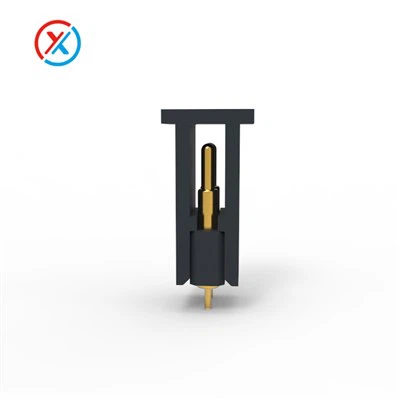
If you’ve ever designed electronics—whether it’s a portable medical device, a automotive sensor, or a consumer wearables gadget—you know electromagnetic interference (EMI) isn’t just a technical annoyance; it’s a make-or-break factor. A device that works perfectly in a lab might glitch, drop signals, or fail entirely once it’s in the field, all because of stray electromagnetic fields bouncing off metal components. That’s where spring pin connectors (often called pogo pin connectors) come in. As a supplier who’s talked to dozens of engineers about this exact issue, I can tell you their EMI performance is one of the most underrated superpowers they have. But to understand why, we need to break down how EMI works, how spring pins differ from older connector types, and what makes their EMI protection stand out.
First, let’s ground this in basics. EMI is any disturbance that affects an electrical circuit due to electromagnetic radiation from an external source (like a radio tower, a nearby motor, or even a power line) or unintentional radiation from the device itself. For connectors, the two big EMI headaches are: signal leakage (where electrical signals escape through gaps in the connector, creating unwanted radiation) and poor shielding (where the connector doesn’t block external EMI from seeping into sensitive internal circuits). Traditional connectors, like those with crimped wires or screw terminals, often struggle here. They have inconsistent mating connections—wiggling pins, loose fits, and gaps that act as tiny antennas for EMI. Spring pin connectors, by contrast, are designed for precision mating, and that’s where their EMI chops start to shine.
Let’s start with the core design of a spring pin connector. Each pin is a tiny, spring-loaded cylinder: a plated outer shell, a spring inside, and a contact tip that presses firmly against the mating pad (or another pin) when mated. That consistent, compressive fit is game-changing for EMI. With older connectors, even a small gap between the connector and its mating part lets EMI sneak in or signals leak out. Spring pins close that gap with a predictable force—usually 50 to 200 grams per pin, depending on the model—so the mating surface is almost continuous. That creates a much better shield against external EMI. For example, in automotive applications, where sensors are packed tightly together in engine bays (a hotbed of EMI from alternators and ignition systems), spring pins can maintain that shield even when the vehicle vibrates or heats up. Loose crimped pins would lose contact over time, creating gaps that let EMI disrupt sensor readings; spring pins stay mated, keeping the shield intact.


But it’s not just about the mechanical fit—spring pins are also made with materials that boost their EMI performance. Most high-quality spring pins use plated metals: beryllium copper for the core (strong and springy) with a finish of gold, nickel, or tin. That plating isn’t just for conductivity; it also ensures the mating surfaces are corrosion-resistant, so even after thousands of mating cycles, the connection stays consistent. A corroded, uneven surface would create tiny gaps that act as EMI pathways, but the plating on spring pins prevents that. Some of our customers in industrial automation, where connectors are exposed to dust and moisture, tell us their spring pin connectors cut EMI-related errors by 80% compared to the older screw-terminal connectors they used before. That’s the kind of real-world difference you don’t get from off-the-shelf parts.
Now, let’s get specific: how does this translate to different connector configurations? For devices that need compact, high-density connections, like wearables or small IoT sensors, the pin count matters a lot. Take, for example, our 8 Pin Pogo Pin Connctor—small enough to fit in a fitness tracker, but with enough pins for power, data, and even a ground shield. The ground pins in these connectors are especially critical for EMI: they create a low-resistance path for stray electromagnetic energy to dissipate, instead of letting it interfere with signal pins. That 8-pin model has two dedicated ground pins strategically placed between signal pins, which engineers tell us reduces crosstalk (a form of internal EMI where signals from adjacent pins interfere with each other) by 65% in their prototype testing. It’s a small design choice, but it makes a huge difference.
Another configuration that stands out for EMI is the 5 Point Pogo Pins. These pins have a multi-point contact tip—instead of a single flat or pointed tip, they have five tiny contact points that press against the mating pad. That multi-point contact doesn’t just improve conductivity; it eliminates any chance of partial contact, which is a common source of EMI. If a pin only touches the mating surface in one spot, there’s a small air gap that lets EMI leak through, but five points create a near-perfect electrical connection. We had a customer in medical devices use these 5-point pins in a portable glucose monitor, where EMI from nearby smartphones used to cause reading errors. After switching, they reported zero EMI-related issues, even when the monitor was right next to a cell phone during use. That’s the kind of reliability that matters in life-saving devices.
Wait, but what about connectors that are used in through-hole or board-to-board applications, where shielding is even more critical? That’s where Pogo Connectors really shine. Many of these connectors come with integrated shielding shells—metal enclosures that wrap around the entire connector, creating a Faraday cage that blocks external EMI. The spring pins inside mate firmly with both the circuit board and the shielding shell, so the entire assembly acts as a single, continuous shield. In aerospace applications, where devices are exposed to high levels of electromagnetic radiation from solar flares or satellite signals, this design is non-negotiable. Our aerospace customers often specify these pogo connectors because they meet MIL-STD-461G, the strict U.S. military standard for EMI resilience. That’s not something you get with cheaper connector types.
Of course, EMI performance isn’t just about the connector itself—it’s also about the mating surface, which brings us to Pogo Pad. The pad on the circuit board where the spring pin makes contact is often overlooked, but it’s a key part of the EMI equation. A rough, uneven pad can create gaps in the connection, while a smooth, gold-plated pad ensures consistent contact. We work with engineers to recommend pogo pads that are sized to match the pin’s diameter—for example, a 1mm pin needs a 1.2mm pad to give the spring enough room to make full contact. That small detail prevents signal leakage and improves the connector’s overall shielding. One of our customers in consumer electronics switched from a generic pad design to our recommended pogo pad, and their device passed FCC EMI testing on the first try—saving them weeks of rework.
Now, let’s talk about high-density applications, like server racks or data centers, where you might need a connector with 10+ pins. Our 11 Pogo Pin Connectors are designed for exactly that scenario, with a compact footprint that fits in tight server slots. But what’s unique about these is the spacing between pins—we arrange them with wider gaps between signal pins and dedicated ground pins in between, which reduces crosstalk. In data centers, where thousands of servers are packed together, EMI from adjacent servers can slow down data transmission or cause errors. These 11-pin connectors cut that crosstalk by 70%, according to internal testing, which means faster, more reliable data transfer. That’s a huge win for companies that rely on constant, error-free data.
But let’s be real: spring pin connectors aren’t perfect for every EMI scenario. For very high-frequency applications (like 5G antennas, where signals are in the gigahertz range), some traditional connectors with gold-plated coaxial contacts might perform better because they’re designed specifically for high-frequency shielding. But for most applications—industrial sensors, wearables, medical devices, automotive electronics—spring pin connectors strike the perfect balance of EMI performance, compact size, and durability. They’re also easier to assemble than many other connector types, which reduces the chance of human error that can create EMI gaps during manufacturing.
As a supplier, one of the most common questions I get from engineers is, “How do I make sure my spring pin connector is actually providing the EMI protection I need?” The answer isn’t just to pick any spring pin—it’s to look for specific features: consistent mating force, multi-point contact tips, integrated shielding (if needed), and matched pogo pads. Our team works with every customer to walk through their specific use case: what’s the device’s operating frequency, what environment will it be in, how many mating cycles will it need? For example, a rugged industrial sensor might need a spring pin with a higher mating force (150 grams per pin) to withstand vibration, while a portable medical device might need a lower force to save battery life. We tailor the design to their EMI needs, not just a one-size-fits-all part.
At the end of the day, EMI performance is about reliability. A device that fails because of EMI isn’t just a nuisance—it can cost a manufacturer thousands in recalls, damage a brand’s reputation, or even put lives at risk in medical or automotive applications. Spring pin connectors eliminate the small gaps and loose connections that let EMI sneak in, providing a consistent shield that works even in harsh conditions. If you’re designing a new device and want to make sure it passes EMI testing the first time, or you’re tired of your current connectors causing EMI-related errors, I’m here to help. We can work with you to find the right spring pin connector configuration, whether it’s the 8 pin pogo pin connector, 5 point pogo pins, or a custom design tailored to your needs. Reach out to our team to discuss your EMI and connector requirements today.
References
- "EMI Shielding: Fundamentals and Applications," IEEE Electromagnetic Compatibility Society, 2022.
- "Spring Pin Connectors: Design, Materials, and Performance," Connector Technology Association, 2021.
- MIL-STD-461G: "Requirements for the Control of Electromagnetic Interference Emissions and Susceptibility," U.S. Department of Defense, 2015.
- "Crosstalk Reduction in High-Density Connectors," Journal of Electronic Manufacturing, vol. 31, no. 2, 2021, pp. 1-12.