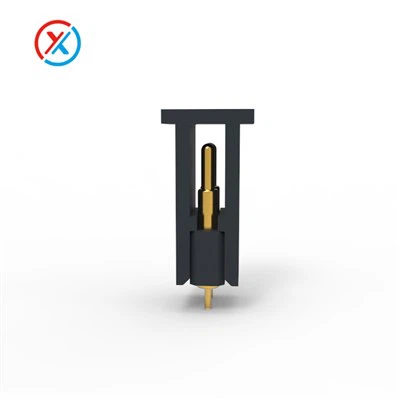
If you’ve ever worked with electronics — whether assembling a smartphone, testing a circuit board, or building a precision medical device — chances are you’ve come across pogopins. These tiny, spring-loaded connectors are the unsung heroes of reliable electrical connections, but have you ever stopped to think about what they’re actually made of? As a pogopin supplier with years in the industry, I’ve spent countless hours diving into material science to ensure our products deliver consistent performance, durability, and precision. Today, I want to pull back the curtain on the materials that make pogopins work, how we choose them, and why the right material matters for every application.
Let’s start with the basics: a pogopin isn’t a single part — it’s an assembly of three key components: the plunger (the part that makes direct contact with another surface), the barrel (the outer housing), and the spring (which delivers the consistent, controlled force needed for the connection). Each part has unique requirements, so we select materials based on factors like electrical conductivity, corrosion resistance, mechanical strength, and durability. Let’s break them down one by one, and along the way, I’ll share examples of how our material choices play out in the products we offer.
Plungers and Barrels: The Face of Electrical Connection
The plunger and barrel are the external surfaces that touch other components (like PCBs, test fixtures, or battery terminals), so their primary job is to maintain a low-resistance electrical path while withstanding thousands of cycles of pressing and releasing. The most common base material for both parts is brass — but not just any brass. We use high-lead brass (like C36000) for most standard applications because it machines easily into tight tolerances, which is critical for pogopins that often have diameters as small as 0.5mm. The lead in this brass acts as a lubricant during machining, reducing wear on tooling and ensuring each plunger and barrel fits together smoothly without binding.
But brass alone isn’t enough. Even the best brass will corrode or tarnish over time, especially in harsh environments like automotive electronics (where humidity and temperature fluctuations are common) or industrial testing (where dust and chemicals are present). That’s why we apply thin, electroplated coatings to both plungers and barrels to boost their performance.
For low-cost, general-purpose applications, we often use nickel plating as a base layer. Nickel is hard, wear-resistant, and provides good corrosion protection. But if you need maximum conductivity — for example, in high-current applications or precision test equipment — we switch to gold plating. Gold is an excellent electrical conductor, resists tarnish completely, and forms a soft, uniform layer that prevents micro-welding (a common issue with harder metals that can cause connections to stick together). For right angle pogo pins that are often used in compact space-constrained designs, the gold plating ensures consistent signal transfer even when the connector is bent at a 90-degree angle, which is a common point of stress. You can see these high-quality right angle designs on our Right Angle Pogo Pin High Quality page, where we use precision-machined brass parts with gold plating to ensure reliability in tight spaces.


For very low-signal applications, like sensors that transmit millivolt-level data, we sometimes use palladium-nickel (PdNi) alloys as a plating material. Palladium offers most of the benefits of gold — corrosion resistance, low contact resistance — but at a lower cost, making it a smart middle ground for applications where gold might be overkill.
Springs: The Heart of Controlled Force
The spring is the component that gives a pogopin its “spring-loaded” nature. It needs to be flexible enough to compress thousands of times without fatiguing, but strong enough to deliver a consistent force (usually between 50g and 500g, depending on the application) to maintain a solid electrical connection — even when there’s minor misalignment between the two components it’s joining.
The most common material for pogopin springs is music wire, a high-carbon steel (typically 1065 or 1095 steel) that’s heat-treated to be strong and elastic. Music wire springs are durable, can handle thousands of compression cycles without losing their spring rate, and are relatively low cost. But like brass, steel is prone to corrosion, so we coat all our springs with either nickel or zinc to prevent rust. For applications that require maximum conductivity and corrosion resistance — like spring pogo pins used in battery contacts for consumer electronics — we use stainless steel springs instead. Stainless steel (especially 302 or 316 grade) is more expensive, but it’s resistant to corrosion from moisture, salt, and other contaminants, making it ideal for outdoor or harsh-environment use.
One product where spring material is critical is double-ended pogo pins, which have a spring in both ends to connect two separate PCBs. The spring in these pins needs to be balanced: too stiff, and it can damage the PCBs; too soft, and it won’t maintain a consistent connection. Our Spring Pogo Pins line uses precision-machined music wire springs with a nickel coating, calibrated to deliver exactly the right force for seamless double-ended connections. If you’re looking for spring loaded pins for through-hole assembly (called DIP pogo pins), our Spring Loaded Pin page uses stainless steel springs that can withstand the higher temperatures and mechanical stress of wave soldering, a common process in PCB manufacturing.
PCB-Integrated Pogo Pins: A Special Case
Pogo pins used directly on PCBs (often called SMT pogo pins, which we list as Pogo Pins Pcb on our site) have their own unique material requirements. Unlike test fixture pogopins, which are often inserted into plastic holders, PCB-mounted pogopins are soldered directly to the board, so their base materials need to be compatible with SMT (surface mount technology) assembly processes. That means they have to withstand the high temperatures of reflow soldering (up to 260 degrees Celsius) without warping or deforming.
For these, we use a more thermally stable brass alloy (like C26000) with a thicker nickel undercoat and a gold flash plating to ensure both solderability and corrosion resistance. The gold flash is a thin layer of gold (only a few millionths of an inch thick) that prevents the nickel from oxidizing during the reflow process, ensuring a strong, reliable solder joint. Without that gold flash, the nickel would oxidize, making it impossible to solder the pin securely to the PCB.
Material Selection: It’s Not One Size Fits All
Over the years, I’ve learned that there’s no “perfect” material for pogopins — only the right material for the job. A pogopin used in a smartphone battery connector doesn’t need the same gold plating as one used in a medical implant, where reliability and biocompatibility are non-negotiable. For medical applications, we even offer titanium plungers and barrels, which are biocompatible and resistant to bodily fluids — a critical feature for devices like hearing aids or implantable sensors.
Another example: industrial test fixtures that are used in dusty factories need pogopins with hard, wear-resistant coatings to handle repeated insertions. Our right angle pogo pins for industrial use have a hard gold plating (thicker than the standard flash) that resists abrasion from dust and debris, ensuring they last for millions of test cycles without losing conductivity.
Common mistakes I see in the industry include using low-cost materials to cut corners, which leads to premature failure. A pogopin made with uncoated brass will corrode after just a few months in a humid environment, causing intermittent connections that can derail a product’s production schedule. That’s why at our company, we prioritize material quality over cost — even if it means a slightly higher upfront price, the long-term reliability saves our customers time and money on rework and returns.
Putting It All Together: Why Materials Matter
At the end of the day, pogopins are small, but their materials have a big impact on the products they’re used in. A electric vehicle charger that uses low-quality pogopins might fail in cold weather because the spring loses its elasticity, while a medical device could give incorrect readings if the plunger’s corrosion creates a high-resistance path. That’s why we work closely with our customers to understand their specific application, then recommend the right materials for their pogopins — whether they need standard brass with nickel plating for a consumer electronics project, stainless steel springs for an automotive sensor, or biocompatible titanium for a medical implant.
If you’re working on a project that requires pogopins, and you’re not sure which materials are right for your needs, our team is here to help. We can walk you through the pros and cons of brass vs. stainless steel, gold vs. palladium plating, and recommend the exact pogopin design that fits your application. Whether you need double-ended pogo pins, right angle pogo pins, or PCB-integrated designs, we have the expertise and materials to deliver a reliable product. Reach out to our team to discuss your requirements and get a custom solution for your project.
References:
- Electrical Contacts: Principles and Applications, R. Holm, 1967
- Machining Properties of Brass Alloys for Precision Components, American Society for Metals, 2008
- Spring Fatigue in Precision Mechanical Devices, Journal of Mechanical Design, Vol. 132, 2010
- Corrosion Resistance of Electroplated Coatings for Electronic Connectors, Surface and Coatings Technology, Vol. 205, 2011
- PCB Assembly Processes for Surface Mount Technology, McGraw-Hill, 2015