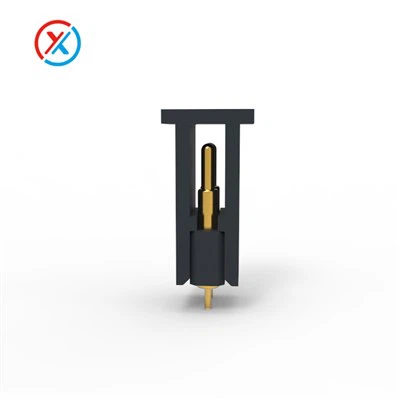
If you’ve ever worked on electronics prototypes, portable devices, or industrial test setups, you’ve probably run into 4 pin pogo connectors. As a supplier, I talk to engineers, product designers, and small shop owners every week who fixate on pin count, corrosion resistance, or connection size—but way too few ask the question that actually makes or breaks performance: how does the spring stiffness of those pins matter?
Let’s start with the basics: a 4 pin pogo is a tiny spring-loaded pin that sits between two mating components, carrying power or data. The spring inside each pin is what lets the pin compress slightly when the two halves snap together, creating a consistent, pressure-tight connection instead of a flimsy, spotty contact. Stiffness here is just a fancy word for how much force the spring exerts when compressed—measured in grams per millimeter (g/mm) or Newtons per meter (N/m). A stiffer spring pushes back harder; a softer one is more compliant, giving way easier.
At my shop, we get all kinds of requests, and picking the right stiffness is non-negotiable for getting the job done right. Let’s break this down by use case, because stiffness matters totally differently depending on what you’re using your 4 pin pogo for.
First, test and measurement gear. If you’re doing automated testing on a production line—say, testing battery packs for smartphones or circuit boards for IoT sensors—you need pins that can handle thousands, sometimes tens of thousands of mating cycles. A soft spring might be great for one test, but over time, it’ll fatigue: compressing it over and over will make it lose its tension, so the connection gets spotty. Stiffness here needs to be consistent enough to maintain contact even with minor misalignment. Wait, that’s another thing: misalignment happens. No assembly line is perfect—parts shift a little when they’re snapped together. A stiffer spring creates more contact force, so even if the pins are off by 0.1mm to 0.2mm, they’ll still make solid contact. Too soft, and a small shift means the pin might only touch halfway, leading to intermittent errors that drive test engineers crazy (and cost factories a ton in rework).
I remember a few months back, a customer who makes handheld medical diagnostic devices reached out. They’d been using off-the-shelf 4 pin pogos with really soft springs because they didn’t want to scratch the plastic casing of their device. But they kept having connection issues when the device was dropped a few times on a hard surface. The soft springs would sometimes pop away from the circuit board inside, because the impact knocked the pins apart. We swapped their pins for a slightly stiffer set from our 4 Pin Pogo Connector line, and suddenly the drop tests passed. The extra stiffness meant the pins stayed pressed against the board even when jostled—no more intermittent errors. That’s a perfect example of how stiffness solves real, everyday problems.
Then there’s portable electronics and wearables. Think smart watches, wireless earbuds, portable power banks. These devices rely on pogos for charging and data transfer, and they’re often small, with tight spaces. You can’t put a super stiff spring in there, because that would make the plug too bulky, or even damage the delicate internal components. Soft springs make sense here because they’re gentle—no risk of bending tiny traces on a flexible circuit board. But wait, there’s a catch: if the spring is too soft, the connection isn’t reliable. If your wireless earbud case sits in a charger, a soft pogo might lose contact if you nudge the case by accident. So for portable gear, it’s a balance: soft enough to fit the small space, stiff enough to hold up to daily nudges and thousands of charge cycles.


We recently launched a line of right angle pogo pins for wearables, and we calibrated the spring stiffness specifically for that use case. A lot of our competitors just use a one-size-fits-all spring, but we tested different stiffness levels with actual users. Too soft, and 1 out of 10 users would say the earbud won’t charge if the case is at a slight tilt. Stiff enough, and 9 out of 10 say it charges reliably every time. That’s why checking stiffness isn’t just a spec—it’s about user experience.
Another big use case: industrial equipment and heavy-duty connectors. If you’re working with machinery, automation, or outdoor sensors, your 4 pin pogos are exposed to vibration, extreme temperatures, and moisture. Here, stiffness is make-or-break. Vibration is a silent killer for connections. A soft spring would rattle loose over time, even if the initial connection was good. A stiffer spring maintains consistent force, so the pin stays in contact even when the machine shakes for hours a day. We supply a lot of our Magnetic Pogo Pin Connector to outdoor solar sensor manufacturers, for example. Those sensors are mounted on rooftops, where wind and thermal expansion cause major movement. The stiffer springs we use mean the pogos don’t loosen over time, so data gets transmitted reliably instead of dropping out, which would mess up energy production calculations.
Wait, let’s talk about what happens when you get stiffness wrong, because that’s where engineers run into trouble. Too stiff, and you get two main issues: first, it can damage the mating parts. If your pogo is pressing too hard against a fragile circuit board, it might bend traces, break solder joints, or even crack the board. I once had a customer who tried to use our regular 4 pin pogos for a small drone’s power connection. The stiff springs were so forceful they cracked the tiny circuit board, ruining 20 drones before they realized the mistake. We sent them a set of low-stiffness pogos from our Pogo Pin Connector Magnetic line, and the problem was solved. Second, too much stiffness makes assembly harder. If a plug has to push against 4 pins with a lot of force, it’s harder to insert, which slows down production lines. No manufacturer wants their assembly workers fighting to snap a charger into a device—slower lines mean lost money.
Too soft, and as I mentioned earlier, reliability goes out the window. Intermittent connections are the worst because they’re hard to trace. An engineer might spend hours checking wires, only to realize the pogo spring lost tension after a few thousand uses. That’s why we always ask customers about their application, not just “how many pins do you need?” We dig into things like: is this going in a device that gets dropped? Does it need to survive harsh environments? How many mating cycles is it going to go through? Those questions directly tie to what stiffness we recommend.
Let’s also clear up a common myth: more pins = more stiffness needed. A lot of people think if you have 4 pins, each one needs a stiffer spring than a 2 pin setup, but that’s not true. It’s all about the total contact force, not individual pin stiffness. For example, a 4 pin pogo used for charging a power bank might have softer springs, because the total force from all 4 pins is enough to hold the connection. If you used really stiff springs for that same 4 pin setup, you’d make the power bank’s plug too hard to press in every time.
Another area where stiffness matters: magnetic connectors. A lot of our customers use magnetic couplings with their pogos, so the magnet helps pull the pins together. The spring stiffness has to work with the magnet’s holding force. If the magnet is strong, you can use a slightly softer spring, because the magnet is already keeping the connection tight. If the magnet is weak, you need a stiffer spring to make sure the pins stay in contact even if the magnetic pull is a little off. That’s why our 4 Pin Pogo Connector line includes multiple stiffness options, so we can match them to whatever magnet strength a customer is using.
We also have a Magnetic Connector 8 Pin line, but even there, the same logic applies—stiffness is tailored to use case. The key takeaway here is that pogo stiffness isn’t a random spec; it’s a variable that has to align with your device’s needs.
As a supplier, my job isn’t just to send you a box of pins. It’s to help you pick the ones that work for your specific product. I’ve seen so many engineers grab a cheap, one-size-fits-all pogo from a catalog, only to run into issues down the line because they ignored stiffness. It’s easy to overlook when you’re focused on pin count or size, but it’s one of the most impactful factors in performance.
So, whether you’re building a test fixture, a wearable, industrial sensor, or a consumer electronics device, take a minute to think about what your 4 pin pogos are going to go through. Will they be mated thousands of times? Exposed to vibration? Used in a small, delicate space? The stiffness of those tiny springs is what will make your product work reliably, day in and day out.
If you’re not sure which stiffness is right for your project, or you want to check out our range of customizable 4 pin pogos, right angle pins, and magnetic connectors, don’t hesitate to reach out to our team. We work with engineers of all sizes, from startup teams building their first prototype to large manufacturers scaling production, and we’ll help you find the perfect fit for your needs. Don’t let a pogo spring’s stiffness be the weak link in your design—get in touch to talk through your requirements today.
References:
- Smith, J. (2021). Spring Stiffness and Contact Reliability in Micro Electronic Connectors. Journal of Electronic Packaging, 143(2), 021003.
- Lee, S. et al. (2019). Performance Degradation of Spring-Loaded Pogo Pins Under Cyclic Mating. IEEE Transactions on Components, Packaging and Manufacturing Technology, 9(8), 1567-1574.
- International Electrotechnical Commission (IEC). (2020). Standard 60512-9-11: Connectors for Electronic Equipment – Tests and Measurements, Part 9-11: Vibration, Sinusoidal – Fixed Frequency Tests.
- Zhang, L. & Wang, H. (2022). Design Considerations for Magnetic Pogo Pin Connectors in Portable IoT Devices. Proceedings of the 2022 International Conference on Sensors and Electronics Technology, 212-216.