

Many engineers face challenges when using connectors that are either too large for miniaturized designs or prone to failure in harsh environments. Traditional connectors are often too bulky for today's compact electronic devices, and their contacts may become intermittent after repeated mating cycles. Simple connectors can also loosen or fail under vibration. High current requirements and special needs-such as customized pogo pin layouts or plating-further complicate these issues.
Pogo pin connectors are specifically designed to address these pain points. They are compact and spring-loaded, maintaining consistent contact pressure, which allows them to withstand thousands of mating cycles while resisting shock and vibration. This makes pogo pins especially suitable for applications where space is limited and high reliability is essential. For example, they help save PCB space and reduce assembly height, making them ideal for compact devices. At the same time, pogo pins are built for durability and vibration resistance, ensuring reliable performance even in demanding environments. In short, pogo pin connectors provide stable, repeatable connections, effectively solving common challenges related to contact reliability, size constraints, and durability in modern electronic design.
What is a Pogo Pins Connector?
A pogo pin connector is an electronic interconnect component composed of two main parts: pogo pins and an insulating plastic housing. When pressure is applied, the plunger compresses and the internal spring retracts; when the pressure is released, the spring pushes the plunger back out. In practical applications, pogo pins can tolerate slight misalignment and compensate for PCB warping or vibration while maintaining reliable electrical conductivity. They are typically plated with durable metals-nickel for wear resistance and gold for low contact resistance-to ensure corrosion-free contact. As a result, pogo pin connectors may appear simple in structure, but they can withstand tens of thousands of mating cycles without performance degradation.
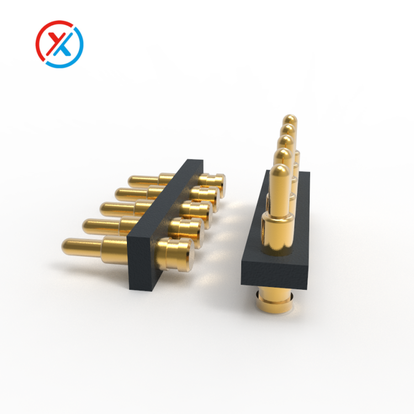
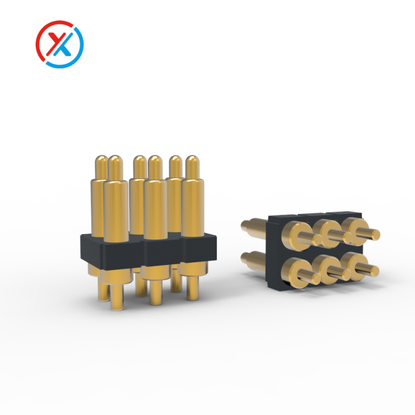
Pogo Pins Selection Guide
When selecting a Pogo pin connector, parameters should be matched to the design requirements. Key parameters include:
Current and Voltage Rating:
Check the maximum current each pin can carry. Standard Pogo pins typically support 0.5–5A continuous current, while high-current versions can handle 5A–60A. Pin diameter and material directly affect current-carrying capacity.
Pin Count and Layout:
Confirm the quantity and spacing of the pogo pins. Pogo contacts can be customized into multi-pin arrays based on PCB layout. Compact devices require fine pitch, while test fixtures or battery contacts may use dozens of pins.
Pin Diameter:
Larger diameters support higher current but occupy more space. Common barrel diameters range from below 0.5 mm to several millimeters, balancing current needs with compact design.
Travel (Stroke):
The compression travel of the pin affects tolerance compensation capability.
Spring Force:
Typical Pogo pin spring force ranges from tens to hundreds of grams. The force must be sufficient to maintain reliable contact without damaging pads. Low-force pins are used for delicate contacts, while higher force is used for more stable connections.
Contact Resistance:
High-quality Pogo pins have low contact resistance. Gold plating further reduces resistance and extends lifespan.
Materials and Plating:
Springs are typically made of stainless steel or beryllium copper, often nickel-plated for wear resistance, with an additional thin layer of gold or palladium for improved conductivity. Gold plating is commonly used for high-reliability or high-cycle applications.
Lifetime (Mating Cycles):
High-quality Pogo pins usually withstand 10,000 to 1,000,000 mating cycles. Applications with frequent connections require higher durability ratings.
Protection and Waterproofing:
For outdoor or harsh environments, waterproof or sealed designs are recommended. Some include O-rings or sealing gaskets to prevent moisture ingress.
Vibration Resistance:
The spring structure provides inherent vibration resistance, but for extreme conditions, high-shock ratings or reinforced housings may be needed.
Mounting Method:
Pogo pins can be purchased individually or as assembled connectors. Installation methods include surface mount (SMT), through-hole, press-fit, or pre-wired (Pogo pin cable).
Magnetic Alignment:
Some Pogo-style connectors include magnetic alignment (e.g., charging docks). Magnetic designs enable easy blind mating, while pure spring Pogo pins offer higher contact force and longer life.
Considering the above factors, for example, carrying 5A current in a compact space may require a 1 mm diameter Pogo pin with long travel, high spring force, and gold plating. For a 10-pin signal board connector, prioritize low profile and alignment features. Always compare datasheet specifications based on electrical load, mechanical tolerance, and lifecycle requirements.
Application Scenarios
Pogo pins connector are widely used in electronic products due to their compact size and reliable mating performance. Typical applications include:
Consumer Electronics: Used in smartphones, tablets, and laptops for battery interconnection, charging interfaces, and more.
Wearables & Charging Docks: Common in smartwatches, fitness bands, and Bluetooth earbuds.
Test Fixtures: Originally developed for PCB and semiconductor testing fixtures.
Medical Devices: Applied in portable monitoring instruments and diagnostic tools.
Industrial & Automotive: Used in sensors, control modules, and automotive test fixtures where compact, vibration-resistant connections are required. Pogo pins can withstand high vibration and temperature variations while maintaining stable contact.
Communication & Data Equipment: Utilized in hot-swappable modules or board-to-board connections, supporting high-speed data transmission with low impedance and reliable signal integrity.
Customization Capabilities
One of the major advantages of Pogo pin connectors is their high degree of customization. Customizable aspects include:
Pin Length and Diameter: Can be specified as needed-longer pins for deep संपर्क, thicker pins for higher current capacity.
Pin Count and Arrangement: Flexible quantity and pitch to match PCB layouts.
Spring Force: Adjustable operating force-low force for delicate pads, higher force for stable connections.
Materials and Plating: Options include gold, palladium, nickel, and tin. Gold is commonly used for low resistance and high wear resistance.
Electrical Rating: Can be customized for high current; some suppliers offer solutions rated at 10–30A or higher.
Sealing / Waterproofing: Options such as O-rings or overmolding can achieve IP67+ ratings, including reverse pin configurations.
Magnetic Features: Optional magnetic alignment or retention functions.
Integrated Cables: Available with Pogo pin cables, where pins are soldered or wired; cable length and connectors can be customized.
FAQ
Q: Do Pogo pin connectors suffer from poor contact?
A: With proper selection and installation, the spring force maintains consistent contact, often making them more reliable than fixed plugs. Gold-plated pins and sealed housings help prevent contamination.
Q: How should I select Pogo pins for high-current applications?
A: Check the current rating in the datasheet. High-current Pogo pins can handle 10A or more. If needed, multiple pins can be connected in parallel.
Q: Can Pogo connectors be waterproof?
A: Yes. Waterproof Pogo pins use rubber seals, specialized housings, or reverse-pin designs. IP67-rated solutions are commonly used in medical and outdoor devices.
Q: What is the typical lifespan?
A: High-quality Pogo pins can withstand tens of thousands of mating cycles (10,000–1,000,000), while high-end test pins can reach up to 1 million cycles. Gold plating helps extend service life.
Q: Can they be customized based on drawings?
A: Absolutely.
Why Choose Pogo Pin Connectors?
Compared to traditional plug-in or soldered connectors:
Pogo pins combine reliability with convenience. Unlike conventional plug-in connectors, they can withstand frequent mating cycles without fatigue. Compared to rigid sockets, their spring force compensates for misalignment, reducing contact issues.
Compared to standard plugs:
They save space and simplify assembly. With self-alignment capability, they do not require precise insertion force. They also eliminate the need for soldered cables, speeding up production and maintenance.
Compared to magnetic connectors:
Magnetic connectors are convenient for blind mating but rely on magnetic force and often have limited lifecycle performance. Pogo pins, on the other hand, use mechanical spring force to maintain stable contact, making them more suitable for high-current and long-term applications.
In summary:
For applications requiring high reliability, compact design, or operation in harsh environments, Pogo pins are often the better choice.
Ready to upgrade your Pogo Pins Connector design?
Tell us your requirements! Provide dimensions or mechanical drawings, and specify current ratings, travel, and environmental constraints (such as waterproofing). Our engineering team can recommend the best Pogo pin solution-from single pins to fully integrated cable assemblies. Contact us today for a quote or samples to ensure a stable and reliable connection for your project.


