



3 Pin Pogo Connector
Your Professional 3 Pin Pogo Connector Supplier
Dongguan Xinteng Electronics Co., Ltd. is a leading high-reliability Pogo Pin connector solution provider in China, integrating R&D, production and sales.
The main solutions include: Pogo pin connector solutions, magnetic connector solutions, pogo pin cable solutions, precision accessories, etc.
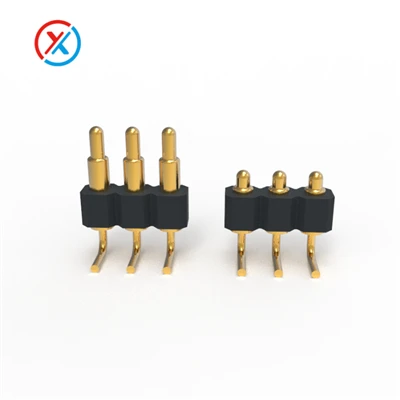


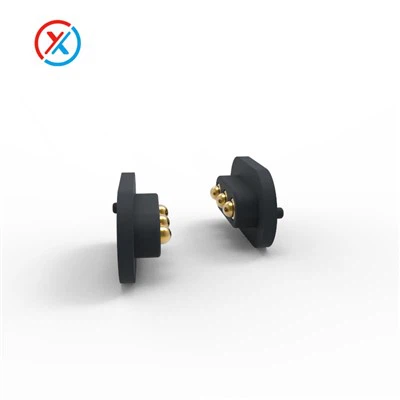

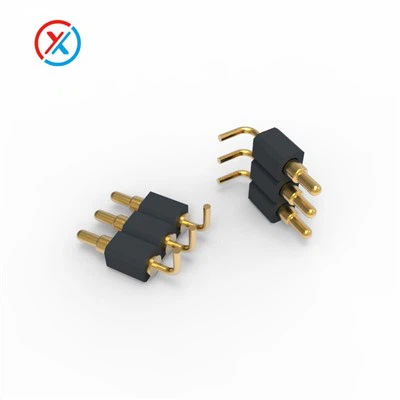

A 3-pin pogo connector is a small housing holding three individual spring-loaded contacts side by side, molded or assembled together so they mate and unmate as one unit instead of three separate pins. That's the difference between this category and a bare pogo pin: the housing sets the pin spacing, keeps the contacts aligned during mating, and usually adds a keying feature so the connector only goes together one way.
Three pins is the smallest step up from a pure power connection. It's enough for power, ground, and exactly one more line, which is why this configuration shows up wherever a design needs to charge something and also carry a single signal, whether that's data, a presence-detect line, or a temperature sense line.
Why Choose us
Quality Assurance
Our products comply with the EU RoHS, REACH, and HF environmental standards, and we have accumulated extensive experience in the fields of pogo pins and pogo pin charging cables.
Comprehensive Patent Portfolio
We offer more than 2000 tailored solutions to customers and have obtained over 100 product patents.
Customization Services
We provide personalized customization services to meet the specific requirements of diverse application scenarios.
Parameter
|
Product model |
RT 1016 |
|
Mechanical |
|
|
Contact force |
70g±20g at 1.0mm working storke (Full stroke 1.5mm) |
|
Life test |
10,000 Cycles |
|
Electrical |
|
|
Rated voltage |
DC 12V |
|
Rated current |
2A Max |
|
Contact resistance of spring pin |
50 Milliohm Max |
|
Operation Temperature |
-25℃ to +80C |
|
Materials |
|
|
Tube/Plunger |
Brass 0.125um Au over 1.5um~2.5um Ni |
|
Spring |
SUS 0.025um Au |
|
Packing |
PE bag / reel packing |
|
Material and coating conform to ROHS and REACH standards |
|

Shape Structure: SMT, DIP, bend, double pin, welding wire structure, integrated type.
Material: C3604 C6801.
Elasticity: ≤ 15g.
Rated Voltage / Current: 5V, 12V, 30V, 120V/0.5A, 3A, 5A, 15A, 30A, 40A.
Connection Method: 90 °, 180 °or other angle.
Mother End Assembly Style: DIP, 90 °bending, welding wire, glue wrap molding, etc.
Mother End Positioning Mode: Concave and convex groove, sealing ring, clamping lock, positioning ear, positioning column, in-mold injection molding.
How it works
Each of the three pins is a complete spring-loaded contact on its own, the same barrel-spring-plunger mechanism used in a bare pogo pin. What the housing adds is fixed spacing between them and a keying feature, usually a notch or asymmetric shape, so the connector can only be mated one way. That matters more here than on a single pin: get a 3-pin connection backward and power and signal can end up swapped, which a keyed housing prevents by making the wrong orientation physically impossible to mate.
Benefits
Durability
3 Pin pogo connectors are designed to withstand thousands to millions of mating cycles, making them ideal for applications that require frequent connections and disconnections. The use of high-quality materials and precision engineering ensures that these connectors maintain their electrical performance over time, unlike traditional spring-based contacts that may degrade more quickly.
Consistent contact pressure
The spring mechanism keeps contact pressure steady, cutting the risk of connection failure from vibration or misalignment, useful anywhere the mating device moves or is handheld.
Fast, simple mating
No precise insertion needed. A simple touch between the two mating surfaces closes the connection, useful for rapid testing, assembly, or hot-swappable use.
Application of 3 Pin Pogo Connector
Wearable charging with basic signal
Smartwatches and fitness trackers commonly pair two power pins with a third line used for cable or dock identification, or for low-speed diagnostics, letting one pogo pad handle both charging and firmware communication.
Battery packs with thermal sensing
Many battery pack designs add a third pin carrying an NTC thermistor signal alongside the two power pins, so the host device can monitor pack temperature during charging instead of relying on the power pins alone.
Simple sensor modules
A single-wire digital interface plus power and ground is enough for many low-complexity sensor modules, and a 3-pin pogo connector is a natural fit where the module needs to be field-replaceable.
Test and calibration docks
Production-line test fixtures for small devices often need power, ground, and a single control or handshake line, the same pin count the end product's own charging contacts already use, so a test dock can reuse that same footprint instead of adding separate test pogo pin pads.
Quality & testing
Every batch goes through 100% spring-force inspection before it ships, checked at rated working stroke rather than sampled. Contact resistance is measured with a four-wire Kelvin setup for a clean reading on a component this small. Materials and plating are checked against RoHS and REACH limits before a job is approved for production, and the factory is ISO 9001 certified.
Standard hard gold plating runs 0.3 to 1.0 μm cobalt-hardened gold over 2 to 5 μm electroless nickel. Spring force across the catalog spans roughly 50 to 500 gf depending on configuration. Standard MOQ starts at 500 pieces; processing and shipping timelines are covered in Logistics below.
Logistics
We will help you to choose the best shipping way according to your detail requirements. By sea, by air, or by express, etc.
The time frame of an order delivery is divided into two parts
Processing time: 10 Days
Shipping methods
DDP, DAP, EXW, and other terms on request
Shipping fee
Calculated per order based on package weight
FAQ