

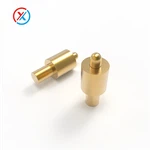


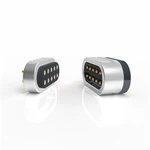
SMT Pogo Pins
Your Professional SMT Pogo Pins Supplier
Dongguan Xinteng Electronics Co., Ltd. is a leading high-reliability Pogo Pin connector solution provider in China, integrating R&D, production and sales.
The main solutions include: Pogo pin connector solutions, magnetic connector solutions, pogo pin cable solutions, precision accessories, etc.


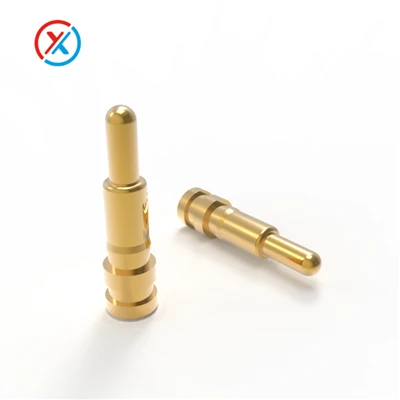


SMT pogo pins are spring-loaded contacts that solder directly to the PCB surface. No drilled holes. You stencil solder paste, place the pin, run it through reflow. Done.
The height range of our SMT series pogo pins varies from 3.3 millimeters to 15.0 millimeters, and the current range is from 0.5A to 50A.Our SMT series of pogo pins range in height from 3.3 mm to 15.0 mm and current from 0.5 A to 5 A.
The shortest ones fit inside wearables where every tenth of a millimeter matters. The taller ones give you more stroke and better tolerance for board flex.
| Component | Material | Coating |
|---|---|---|
| Plunger | C3604/C6801 brass | Gold, nickel, silver, palladium, platinum, etc. |
| Barrel | C3604/C6801 brass | Gold, nickel, silver, palladium, platinum, etc. |
| Spring | Stainless steel | Gold, nickel, silver, palladium, platinum, etc. |
types of CNC machining
Lorem ipsum dolor sit amet consectetur adipisicing elit.
Quality & testing
Every batch goes through 100% spring-force inspection before it ships — each pin is checked at its rated working stroke, not sampled. Contact resistance is measured with a four-wire Kelvin setup, which is what it takes to get a clean reading on a component this small without lead resistance skewing the result. Plating and base materials are checked against RoHS and REACH limits before a job is approved for production.
For new designs, we do a free layout review before tooling starts — checking pad size, stroke clearance, and mounting method against your PCB file, so problems show up on screen instead of in an incoming inspection three weeks later. Small-batch orders are supported for prototyping and pilot runs; tell us your target quantity and timeline and we'll confirm what's realistic.
How it works
SMT pad Plunger Spring Barrel 0.8mm working stroke
The barrel solders to the PCB pad with standard paste and goes through reflow with the rest of the board. Inside, a compression spring pushes the plunger out to its free length; when the plunger meets a mating pad or connector, it's pushed back down the barrel, and the spring force is what keeps the contact closed.
Working stroke is the distance between the plunger's free position and where it sits in normal use. For the 1120-1 above, that's 0.8mm out of 1.0mm full travel — a 0.2mm margin before the spring bottoms out. That margin matters: push the plunger past full stroke in the mated position and the spring takes a permanent set, dropping contact force a little more on every cycle after that.
Parameter
|
Product model |
Standard products |
|
Mechanical |
|
|
Life test |
10000 to 1,000,000 Cycles |
|
Electrical |
|
|
Rated voltage |
DC 5V to 240V |
|
Rated current |
0.5A to 40A Max |
|
Contact resistance of spring pin |
50 Milliohm Max |
|
Environmental performance |
|
|
Operation Temperature |
-25℃ to +80℃ |
|
Salt Spray |
48H to 168H |
|
Packing |
PE bag / reel packing |
|
Material and coating conform to ROHS and REACH standards |
|
Functions of SMT Pogo Pins
Power Transmission
High-current SMT pogo pins can handle significant power loads, suitable for charging applications or power distribution.
Data Transmission
They can reliably transmit high-speed data signals, essential for infotainment systems, ADAS sensors, and telematics.
Signal Transmission
Low-level analog or digital signals for sensors and control modules are also well-suited for SMT pogo pins.

SMT pogo pins work by using a spring-loaded mechanism to create a temporary electrical connection between two devices. When the pogo pin is pressed against a PCB, the metal contacts on the tip of the pin make contact with the copper traces on the PCB.This creates an electrical connection that can be used to transfer data, power, or signals between two devices.The spring-loaded mechanism allows the pogo pin to make a secure connection with the PCB while also being able to withstand repeated use.When not in use, the pogo pin is retracted into its body so that it does not make contact with the PCB. This prevents short circuits and other problems that can occur when two metals come into contact with each other.
The Usage Method Of SMT Pogo Pins
Solder paste on a pad
The simplest option — position the connector on the pad and reflow it like any other SMT part. Least stable of the group; vibration or mating pressure can shift or break off pins, so we don't recommend it unless the application is genuinely low-stress.
Plug-in tails through the board
The pin's tail threads through a hole in the PCB, the way most larger components mount. The tail carries extra mechanical support, which improves stability over paste alone.
Housing with legs
A housing with mounting legs secures the whole connector to the board, while the pins themselves sit on gold pads under pressure or paste. Stable enough for most standard applications.
Plug-in tails plus housing
Combines the two methods above. This is what we recommend by default when the design allows it — it's the most mechanically stable option in this list.
Cable connection
A small solder cup at the back of the pin takes a soldered wire lead, giving a flexible connection that can move or be repositioned after mounting. Used when a rigid, direct connection isn't practical.
Spring tail
A flat spring piece attaches to the end of the pin on the PCB — useful for right-angle pins, and better suited to applications with frequent movement or wear than a fixed mount.
Double-ended pogo pins
Press-fit directly into the device housing or a plastic carrier. Sturdy, and the double-ended design makes individual pins easy to swap out if one wears down.
Additional Information
|
Shipping |
We offer various shipping methods, including sea freight, air freight, and express delivery, depending on the order size and destination. |
|
Terms Of Payment |
We usually accept T/T, L/C, Paypal, Credit card, etc. If you prefer other payments terms, please feel free to discuss with us. |
FAQ