


Pogo pin connectors provide one solution. Their spring-loaded contact structure allows electrical connections to be established and released repeatedly without requiring a conventional plug-and-socket arrangement at every interface. They are widely used in charging contacts, battery connections, electronic test fixtures, docking stations, and compact modular assemblies.
However, the value of a pogo pin is not determined by its size or appearance alone. Contact geometry, spring force, plating quality, dimensional accuracy, and the structure of the mating assembly all influence electrical stability and mechanical durability. As intelligent devices become more compact and their operating requirements more demanding, precision pogo pin connections play an increasingly important role in product design.
1. Reliable Electrical Connections Keep Intelligent Devices Operating Properly
Modern electronic products contain multiple components that must work together. Processors, sensors, displays, batteries, communication modules, and other electronic assemblies depend on reliable power delivery and signal connections.
Pogo pins can provide these connections where a compact, removable, or repeatedly mated interface is required.
Smart Wearable Devices
Smartwatches, fitness bands, health-monitoring devices, and other wearables have limited internal space. Their charging interfaces must fit within compact housings while maintaining reliable contact during repeated use.
Magnetic pogo pin connectors are commonly used in wearable charging systems. Magnetic attraction helps align the mating components, while the spring-loaded contacts maintain electrical contact within the specified working stroke.
Reliable contact helps reduce charging interruptions caused by insufficient compression or minor movement between the connector halves. It also supports consistent electrical performance as the charging interface is repeatedly connected and disconnected.
However, stable contact depends on the complete design. The contact force must be sufficient without placing excessive stress on the mating pads, and the connector must be aligned correctly during assembly. Contamination, worn plating, or an unsuitable working stroke can still cause intermittent contact even when the pogo pin itself is manufactured accurately.
Intelligent Automotive Electronics
Automotive electronics operate under demanding conditions that may include vibration, temperature changes, humidity, and repeated mechanical loading. Certain automotive applications use spring-loaded contacts in removable modules, charging interfaces, test fixtures, and specialized electronic assemblies.
In these applications, contact reliability depends on the connector's ability to maintain the required force and electrical path while accommodating the mechanical conditions of the installation.
Precision pogo pins may be suitable for particular compact or repeatedly connected interfaces, but they are not a universal replacement for conventional automotive connectors. Safety-critical circuits and high-speed communication links require connector designs qualified for their specific electrical, mechanical, and environmental requirements.
The connector should be selected and validated according to the actual application rather than assumed suitable simply because it uses a spring-loaded contact structure.
Modular Electronic Products
Some electronic products use removable modules or accessories that need to connect without permanent wiring. Pogo pins can provide power and, where the electrical design supports it, signal connections between these components.
Because the contact can retract under pressure and return when released, the interface can accommodate a defined amount of variation in the assembled dimensions. This is useful when the product requires repeated attachment, replacement, or docking.
The benefit depends on correct mechanical positioning. If the mating components move excessively or apply uneven pressure, one or more contacts may lose reliable electrical engagement.
2. Precision Pogo Pins Help Maintain Consistent Electrical Performance
As intelligent devices add functions and operate with tighter electrical margins, contact resistance and connection stability become important design considerations.
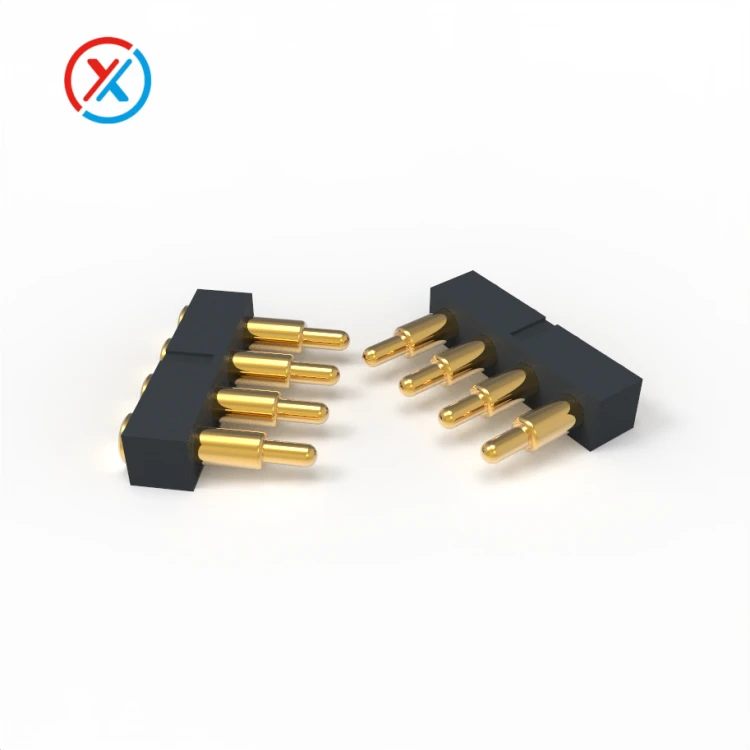
A pogo pin typically consists of a plunger, an internal spring, and a barrel. The plunger touches the mating surface, the spring supplies the return force, and the barrel guides the plunger and may form part of the conductive path.
Small variations in the dimensions or surface condition of these components can affect how the connector performs.
Contact Resistance
Electrical current passes through the mating interface and the designed conductive path inside the pogo pin. If the contact surfaces are contaminated, worn, or insufficiently compressed, resistance may increase.
Higher resistance can cause additional voltage drop and heat generation, particularly in power-delivery applications.
Precision manufacturing helps control the plunger geometry, barrel dimensions, and internal contact relationship. Appropriate surface treatment can also help maintain stable electrical contact over repeated cycles.
Gold plating is often used on functional contact surfaces because it resists oxidation under normal operating conditions. Nevertheless, plating quality, coating thickness, adhesion, and wear performance must match the application. Gold plating alone cannot compensate for poor contact geometry or excessive resistance elsewhere in the electrical path.
Signal Transmission
Pogo pins can carry signals as well as power, but signal performance depends on the requirements of the interface.
For low-speed control signals or simple electrical connections, stable contact resistance and reliable continuity may be the main concerns. High-speed digital and radio-frequency applications require additional attention to impedance, parasitic inductance and capacitance, grounding, and signal-path geometry.
A precision contact structure helps establish repeatable electrical connections, but it does not automatically guarantee high-speed data transmission. The complete connector and circuit layout must be designed and tested for the intended signal characteristics.
3. Precision Manufacturing Supports Miniaturization
Intelligent devices often need to accommodate more functions without increasing their overall dimensions. This creates pressure to reduce connector size while maintaining reliable mechanical movement and electrical performance.
Pogo pins can support compact layouts because their spring-loaded structure allows a contact to compress within a relatively small space. Multiple contacts can also be arranged in a defined pattern to connect several electrical paths through one interface.
As the contact pitch becomes smaller, manufacturing tolerances become more important.
The plunger must move freely inside the barrel, but the clearance cannot be chosen arbitrarily. If the fit is too tight, friction may cause sticking or prevent the plunger from returning. If it is too loose, the plunger may move laterally and produce inconsistent internal contact.
The finished dimensions must also account for the plating layer. Excessive coating buildup can reduce internal clearance, while inadequate control of surface finish may increase friction or wear.
Precision machining, controlled plating, and consistent assembly processes help maintain the intended geometry across production batches. Dimensional inspection should be combined with functional checks of plunger movement, spring force, and electrical resistance.
Miniaturization is therefore not simply a matter of reducing the outside diameter. The entire internal structure must be redesigned and validated for the available space.
4. Mechanical Reliability Matters During Repeated Connection
Many intelligent devices are used daily and may be connected to charging cables, docking stations, or test equipment hundreds or thousands of times over their service life.
Each mating cycle places mechanical stress on the pogo pin. The plunger moves against the barrel, the spring compresses, and the exposed contact surface engages with the mating pad.
Several design factors influence durability.
Spring force: The spring must provide sufficient force to maintain contact at the intended working height. Too little force may lead to intermittent contact, while excessive force can accelerate wear and damage the mating surface.
Working stroke: The assembled compression must remain within the specified operating range. Excessive compression can overstress the spring or damage internal components.
Surface durability: The plunger and barrel require suitable materials and surface finishes for the expected wear conditions. The mating pad must also be compatible with the contact material and finish.
Alignment: The connector should be loaded along its intended axis. Side loading or an angled mating surface can increase friction and accelerate wear.
Contamination control: Dust, solder residue, oils, and other debris can interfere with movement or electrical contact. Manufacturing cleanliness and appropriate protection are particularly important in compact assemblies.
A connector's cycle-life rating should be assessed using its specified test conditions. A high mating-cycle figure does not guarantee equivalent performance under every force, temperature, vibration level, or current load.
5. Environmental Resistance Depends on the Complete Assembly
Intelligent devices increasingly operate in outdoor, mobile, and industrial environments. Moisture, dust, corrosive substances, and temperature variation can affect connector performance.
Pogo pin connectors can be incorporated into assemblies designed for these conditions, but their spring-loaded structure does not automatically provide waterproofing or dust protection.
Environmental performance depends on several elements, including the housing, seals, contact layout, material selection, and protection of exposed electrical surfaces.
For a wearable device, for example, sweat and moisture may affect the charging contacts even when the main enclosure is water-resistant. For industrial equipment, contaminants may accumulate around the contact interface and interfere with repeated operation.
Material and plating selection should reflect the expected exposure. Corrosion-resistant materials and suitable contact finishes can help, but environmental ratings must be verified on the finished assembly.
Temperature also affects performance. Heat generated by electrical resistance may combine with ambient temperature to increase the temperature around the contact interface. Prolonged elevated temperatures can affect spring force retention and material properties.
For demanding applications, verification may include temperature cycling, humidity exposure, vibration testing, contact-resistance measurements, and repeated-mating tests.
6. Precision Pogo Pin Design Supports Product Innovation
The development of more compact intelligent products has encouraged connector manufacturers to improve materials, manufacturing processes, and internal structures.
Advances in material selection can help balance conductivity, hardness, corrosion resistance, and mechanical durability. More controlled machining and plating processes can improve dimensional consistency and coating quality. Changes to the plunger geometry, spring arrangement, and contact layout can address specific electrical or mechanical requirements.
However, innovation should be driven by a defined engineering need. A more complicated internal structure does not automatically produce a better connector, and a specialized coating does not guarantee better performance in every application.
For customized products, the connector should be developed around the installation space, contact count, required current, operating stroke, mating material, and environmental conditions.
Dongguan Xinteng Electronics Co., Ltd. supplies pogo pin and magnetic connector solutions and also provides drawing-based precision machining for nonstandard packaging machinery components, including guide sleeves, locating blocks, precision support plates, and connector mounting seats. This machining capability is relevant to custom assemblies in which mechanical positioning and dimensional tolerances influence how the electrical contacts engage.
The engineering process should combine mechanical drawings, electrical specifications, prototype evaluation, and validation testing before mass production. This approach helps ensure that the connector meets the needs of the finished product rather than relying on general performance claims.
7. What Should Engineers Consider When Selecting Precision Pogo Pins?
Selecting a pogo pin requires an understanding of both the electrical requirements and the mechanical environment.
The main considerations include the rated current and voltage, contact resistance, contact force at the working height, working stroke, installation dimensions, plating specification, expected mating cycles, and environmental exposure.
For power applications, temperature rise and voltage drop should be checked at the intended current. For signal applications, the required communication characteristics and signal integrity must also be evaluated.
The mounting structure is equally important. Correct positioning ensures that contacts meet their intended pads and compress within the specified range. Where several pins operate together, the design should account for dimensional tolerances to avoid uneven contact force.
Testing should reflect the finished assembly. A pogo pin that performs well in isolation may behave differently after installation if the housing, PCB, or mating component introduces misalignment or additional mechanical loading.
Precision pogo pin connections are most effective when the contact, mounting structure, and electrical circuit are treated as one integrated design.
FAQs About Precision Pogo Pin Connections
1. Why Are Pogo Pins Important in Intelligent Devices?
They provide compact, spring-loaded electrical connections for applications such as charging, battery contacts, modular interfaces, and electronic testing. Their ability to connect and disconnect repeatedly makes them useful where a permanent connection is unnecessary or impractical.
2. Do Precision Pogo Pins Guarantee Stable Data Transmission?
No. They can provide repeatable electrical contact, but signal performance also depends on contact geometry, grounding, impedance, circuit layout, and the required data rate. High-speed applications need appropriate design and validation.
3. Can Pogo Pin Connectors Withstand Vibration and Moisture?
Some designs are engineered and tested for vibration or moisture exposure, but the performance depends on the connector structure and complete assembly. The working stroke, contact force, mechanical retention, materials, plating, and enclosure protection must all match the application.
4. What Is the Most Important Factor in Pogo Pin Reliability?
There is no single factor that determines reliability. Spring force, working stroke, contact resistance, plating quality, dimensional accuracy, alignment, and operating conditions interact with one another. The connector should be selected and tested according to the actual requirements of the finished product.


