





Camera Lens Connector
Dongguan Xinteng Electronics Co., Ltd. is one of the most reliable manufacturers and suppliers of camera lens connector in China, featured by quality products and good service. Welcome to wholesale bulk durable camera lens connector in stock here from our factory. Also, customized service and OEM&ODM service are available.
camera lens connector
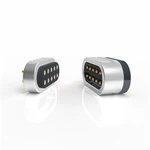
This 12-pin lens connector features an overall curved shape, perfectly conforming to the curved surface of the lens adapter. This not only saves space but also ensures uniform force on each contact point during insertion, preventing single-point contact failure. It typically has 8 to 12 pins and utilizes highly conductive copper alloy pins with hard gold or silver plating.
The gold plating thickness is typically 3 to 5 μin, effectively reducing contact resistance and improving signal stability.
It has a rated voltage of 12V DC, a maximum rated current of 1A, and a maximum contact resistance of 50 milliohms per pin. It operates stably over a wide operating temperature range of -25°C to 80°C, with a high-temperature resistance of up to 260°C. Its materials and plating comply with ROHS and REACH environmental standards.
Product Parameters
|
Product model |
RT-1118 |
|
Mechanical |
|
| electroplating layer | Gold or silver plating available |
|
Life test |
500 cycles |
| number of pins | 12pin/8pin |
|
Electrical |
|
|
Rated voltage |
DC 12V |
|
Rated current |
1A Max |
|
Contact resistance of spring pin |
50milliohm Max |
|
Environmental performance |
|
|
Operation Temperature |
-25℃ to +80℃ |
|
Salt Spray |
24H |
|
Packing |
PE bag / reel packing |
|
Material and coating conform to ROHS and REACH standards |
|
Connector Features
A lens adapter is the part that connects the base of an interchangeable lens to the camera body. The lens mount structure matches the camera, and the lens connector is used to secure the lens and connect it to the camera's functional modules. Traditional adapters primarily served to secure the lens and maintain the distance between the back of the lens and the sensor. Modern adapters use mechanical levers or electronic contacts to transmit metering and autofocus information, enabling control of aperture, shutter speed, and focus.

Camera Lens Connector and Lens Ring
Our curved camera lens connector is primarily used as an electronic communication interface in interchangeable lens systems, transmitting signals, power, and control contacts between the camera body and lens. This multi-pin connector's structural design balances mechanical strength, spatial compatibility, and electrical reliability, making it a common connection method used in high-end lens adapters.
Who we are
Dongguan Xinteng Electronics Co., Ltd. is a leading high-reliability Pogo Pin connector solution provider in China, integrating R&D, production and sales. The factory covers an area of 2,700 square meters. The R&D team composed of 15 experienced engineers focuses on special scenarios such as innovation, miniaturization, high current, waterproof performance, high corrosion, and long life.
The factory and integrated automated assembly provide cutting-edge connection technology for automotive electronics, Internet of Things, consumer electronics, medical beauty equipment and other fields, and promote global technological innovation.

FAQ
Hot Tags: camera lens connector, China camera lens connector manufacturers, suppliers, factory
Previous
No InformationYou Might Also Like


Send Inquiry