





Gold-Plated Pogo Pins High Quality
Dongguan Xinteng Electronics Co., Ltd. is one of the most reliable manufacturers and suppliers of gold-plated pogo pins high quality in China, featured by quality products and good service. Welcome to wholesale bulk durable gold-plated pogo pins high quality in stock here from our factory. Also, customized service and OEM&ODM service are available.
Gold-plated Pogo pins high quality
This high-lifespan Pogopin boasts 100,000 plug-in/plug-out cycles, a rated voltage of 12V, and a maximum current of 2A. It's suitable for low-current and low-power device connections, enabling it to handle common low-power device connectivity needs. This product avoids overload and overheating issues and features self-cleaning properties, making it ideal for devices requiring reliable power connections, such as smart devices, battery packs, and power modules.
The raw materials and coatings used in our product manufacturing comply with RoHS (Restriction of Hazardous Substances) and REACH environmental standards, containing no substances harmful to human health and meeting international environmental requirements. It is suitable for the global market, especially for industries with stringent environmental regulations.
Product Parameters
|
Product model |
RG-1329 |
|
Mechanical |
|
|
Contact force |
80g±20g at 0.65mm working storke Full storke 0.8mm |
|
Life test |
100,000 cycles |
|
Electrical |
|
|
Rated voltage |
DC 12V |
|
Rated current |
2A Max |
|
Contact resistance of spring pin |
50 milliohm Max |
|
Environmental performance |
|
|
Operation Temperature |
-25℃ to +60℃ |
|
Salt Spray |
48H |
|
Packing |
PE bag / reel packing |
|
Material and coating conform to ROHS and REACH standards |
|
Structure and Parameters
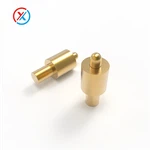
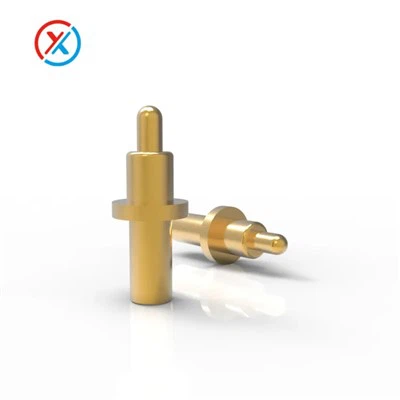
This is a pogo pin with a stepped design. The stepped design improves the contact stability and increases the insertion/extraction force of the pogo pin. This allows the pogo pin connector to maintain better contact pressure during use, ensuring more stable current transmission. The gold-plated pogo pin has a tip diameter of 0.9mm and a total height from pin to tip of 6.85mm, achieving a miniaturized structure while ensuring good electrical performance.

Precautions For Using Pogo Pin
- En cuanto al diseño de la carrera de compresión, esta suele ser de 2/3 de pulgada de la carrera total. Una presión y empuje insuficientes provocarán una impedancia inestable; por el contrario, una presión excesiva dañará la abertura del tubo, causando que los contactos de los pines de contacto se bloqueen.
- Durante el montaje, se debe tener cuidado de no aplicar una fuerza excesiva en la abertura del tubo, ya que esto podría causar deformación y bloquear los contactos de los pines de contacto.
- Los contactos de la batería que se acoplan con los pines de contacto o los contactos dorados del FPC deben estar libres de suciedad, oxidación, etc., para garantizar una conexión estable.

Manufacturing Requirements for the Stepped Structure of Gold-Plated Pogo Pins
The stepped structure design of DIP-type Pogo Pins aims to ensure contact stability, especially in scenarios requiring frequent insertion and removal. This design allows for a more uniform pressure distribution at the pin contact points, extending the lifespan of the Pogo pin connector and reducing contact resistance fluctuations.
- High Requirements for Stepped Structure Design and Manufacturing
Product engineers require extremely high precision in the design of the stepped structure. The height and angle of each step must be controlled at the micrometer level; even slight deviations can affect the contact effect, potentially leading to poor contact and uneven crimping. Therefore, when manufacturing these Pogo Pins, designers must consider not only contact performance but also possess extensive manufacturing experience.
In product manufacturing, this typically requires precision equipment such as CNC milling machines, laser cutting, and EDM. These machines ensure that every detail of the step is precisely executed, and different processing methods can be selected based on the complexity of the materials and structure.
- Precision Materials and Surface Treatment
We select only the most suitable materials. Stepped Pogo Pins typically require alloys with good elasticity, such as copper alloys. These materials not only need to meet mechanical strength requirements but also possess good electrical conductivity and corrosion resistance. To enhance wear resistance and prevent corrosion, the surface of the Pogo Pins is usually plated with gold or nickel. These processes require very fine precision to ensure uniformity and adhesion of the plating.
- Quality Control and Testing
Quality control is essential in the production of stepped Pogo Pins. Each production stage requires rigorous inspection, from dimensional accuracy to functional testing.
Gold-Plated Pogo Pins: High Quality Design Principles
1. Uniformly Distributed Contact Pressure
The core design goal of the stepped structure is to optimize the contact pressure between the Pogo Pin and the target connector. Normally, the contact pressure of the Pogo Pin should be uniform; otherwise, poor contact or premature wear can easily occur during insertion and removal. The stepped structure design ensures that the contact pressure at each layer is neither too high nor too low through a phased, gradually increasing pressure, thus achieving a uniform distribution on the contact surface. This structure effectively avoids material fatigue caused by excessive local pressure, ensuring that the pins can bear force evenly over long-term use.
2. Extended Service Life
Another design principle of the stepped structure is to extend the service life of the Pogo Pin. With traditional Pogo Pins, uneven pressure distribution can easily create high-stress areas at the contact points, leading to wear or metal fatigue. The stepped design, by gradually changing the pin height and contact angle, makes the friction more uniform during contact. This not only reduces the generation of high-stress areas but also reduces failures caused by excessive local wear during contact. Therefore, the stepped structure significantly improves the durability of Pogo Pins and reduces failures caused by wear.
3. Reduces Contact Resistance Fluctuations
The stability of contact resistance is crucial to the performance of Pogo Pins, especially in precision electronic equipment. The stepped structure design, through progressively increasing contact pressure, ensures a consistent current conduction path on the contact surface during each insertion and removal, avoiding large fluctuations in contact resistance. Unstable contact resistance affects signal transmission quality and can even lead to electrical faults. Therefore, the stepped design effectively improves the electrical performance of the connection, ensuring stable electrical performance of the Pogo Pin over long-term use.
4. Reduces Contact Surface Wear
In various industry applications, the contact surface of the Pogo Pin is a critical component that withstands frequent insertion and removal. Another important principle of the stepped structure is to reduce wear through a more precise contact surface design. The stepped design optimizes the contact area at each contact point, and the phased contact avoids excessive friction at the same location. This effectively extends the life of the contact surface and reduces performance degradation caused by wear, which is particularly important in high-frequency insertion and removal scenarios.
5. Adaptability to Diverse Working Environments
Another design consideration for the stepped structure is its adaptability to different working environments. In environments with high temperatures, humidity, or salt spray, ordinary contact structures are prone to oxidation or corrosion, while the stepped structure effectively disperses the impact of the external environment on the contact surface. By increasing the number of contact points on the contact surface, the stepped design makes the stress and current distribution at each contact point more uniform, providing stable performance even in harsh environments.
6. Increased Manufacturing Precision Requirements
During the manufacturing process, the stepped structure design places higher demands on machining precision. The height, angle, and position of each step must be extremely precise; even small errors can affect the final contact performance and service life. To ensure this precision, high-precision CNC equipment, laser cutting, or EDM technology is typically required. This is also a challenge in stepped structure design; manufacturers need to ensure process stability and high precision to produce Pogo Pins that meet requirements.
7. Trade-offs Between Manufacturing Complexity and Cost
While the stepped structure offers significant performance improvements, the increased complexity and cost during design and manufacturing are undeniable factors. The multi-layered design of the stepped structure requires higher machining precision and more production steps, thus resulting in relatively higher production costs. Furthermore, the increased steps also mean a longer production cycle.
Dongguan Xinteng Electronics Co., Ltd
Dongguan Xinteng Electronics Co., Ltd. is a company with many years of experience in the connector industry, primarily focusing on precision Pogo Pins, magnetic connectors, and various customized connection solutions. In terms of quality, Xinteng has a well-established production and testing process, with strict controls from incoming materials, processing, plating, assembly to final testing. Routine tests such as contact resistance, life cycle testing, high and low temperature testing, and salt spray testing are all performed, and full or random inspections are conducted before shipment to ensure the stability of each batch.
The company's clients span consumer electronics, medical equipment, smart home, and industrial control industries, many of whom are long-term partners. Their delivery time control is also relatively stable; standard parts can be produced in a short time, making them suitable for customers with high delivery speed requirements.

FAQ
Hot Tags: gold-plated pogo pins high quality, China gold-plated pogo pins high quality manufacturers, suppliers, factory, pogo pin 1.27 mm, double sided pogo pins, small pogo pins, contact pins, Pogo Pin Female, pogo pin 1 27 mm
Previous
2mm Pogo PinYou Might Also Like



Send Inquiry