


Engineers frequently assume that adding metallic plating to precision springs increases their mechanical stiffness through dimensional addition. This misconception leads to specification errors and field failures. In reality, the 2–5 μm thickness typical of nickel or gold deposits contributes negligible geometric change to wire diameter. The critical force variations-typically ranging from -2% to -15%-originate from metallurgical interactions between the plating process and the spring substrate, not from the added material mass.
Surface Preparation Effects
Pre-plating treatment sequences involving alkaline cleaning and acid activation chemically etch the spring wire surface. This micro-erosion reduces wire diameter by 1–3 μm, slightly decreasing the spring constant. More critically, aggressive acid exposure creates microscopic surface pitting that becomes initiation sites for fatigue cracks. For outdoor applications targeting five-year service life, this surface degradation proves more consequential than minor stiffness reduction. Process control requires restricted acid exposure duration and low-etch activation chemistry to preserve wire integrity.
Hydrogen Embrittlement Mechanisms
Acid cleaning and cathodic electroplating generate atomic hydrogen that penetrates the metal lattice. This phenomenon creates distinct failure modes depending on substrate composition.
For 17-7PH stainless steel springs, hydrogen absorption causes delayed catastrophic failure. Initial spring force measurements appear normal, but hydrogen migrates to grain boundaries during subsequent weeks, causing intergranular cracking and force collapse. Mandatory hydrogen relief baking at 200–230°C for 2–4 hours after plating drives out absorbed hydrogen without compromising the precipitation-hardened structure. Omitting this step risks delayed fracture after assembly pre-loading.
Beryllium copper springs present the opposite constraint. These alloys achieve strength through low-temperature age hardening (typically 300°C precipitation treatment). Exposure to baking temperatures above 150°C causes over-aging, softening the matrix and reducing spring force by 20% or more. Consequently, beryllium copper requires hydrogen minimization through process chemistry optimization rather than post-plate thermal treatment.
Plating Stress and Thermal Interactions
Electroplated nickel generates intrinsic stress that mechanically interacts with the substrate. Tensile stress in the deposit effectively "pulls" the spring wire, slightly reducing measured force and promoting microcrack formation. Compressive stress coatings marginally improve fatigue resistance. Industry standard practice specifies low-stress nickel formulations for underlayers to minimize these effects.
Thermal excursions during plating or baking affect the two spring materials differently. Beryllium copper springs tolerate standard plating temperatures (60–80°C) without degradation but suffer permanent softening if exposed to high-temperature hydrogen relief cycles. The 17-7PH stainless grade accommodates 200°C baking without mechanical property loss, provided temperature remains below the aging threshold.
Quantitative Force Variations
Well-controlled plating processes on beryllium copper springs typically yield force reductions of 3–8% compared to unplated baseline. Excessive acid etching expands this range to 10–15% with increased scatter. Accidental high-temperature exposure causes catastrophic force loss exceeding 20%.
Properly processed 17-7PH springs with appropriate hydrogen relief exhibit 2–6% force reduction. However, skipping the relief bake creates a deceptive scenario where initial force appears acceptable, followed by progressive decay during storage or early service life-a latent defect particularly dangerous for long-term outdoor deployments.
Specification and Verification Protocols
Spring force measurement should occur prior to plating, with post-plate verification reserved for process monitoring rather than acceptance sorting. Design specifications must incorporate a 5% force decay allowance to accommodate plating-related variations. For stainless steel springs, drawings must explicitly mandate post-plate hydrogen relief with specified temperature and duration. Beryllium copper designs must prohibit high-temperature baking, with hydrogen control achieved through plating chemistry parameters.
Incoming inspection should include a 72-hour static compression test at working deflection to identify time-dependent force decay. Immediate post-plate force deficiency indicates acid attack; delayed force loss suggests hydrogen embrittlement or stress relaxation mechanisms.
Frequently Asked Questions
Q1: Can I compensate for plating-related force loss by specifying a thicker spring wire? Yes, but this approach requires careful calculation. Increasing wire diameter by 3–5% compensates for typical 5–8% force loss, but alters the spring rate and solid height. Alternatively, specify higher initial force with the understanding that post-plate values will settle lower. For critical applications, we recommend prototype validation testing with your specific plating stack-up to establish accurate compensation factors before production release.
Q2: Why does my beryllium copper spring show acceptable force immediately after plating but fail after two weeks?
This pattern indicates either residual hydrogen damage or surface pitting from excessive acid cleaning. Beryllium copper does not typically suffer from hydrogen embrittlement cracking like steel, but hydrogen can accumulate at the copper-beryllium interface, creating blisters that reduce effective wire cross-section. The delay represents the time required for hydrogen diffusion to critical concentrations. Review your activation acid concentration and consider adding a mild thermal treatment (80–100°C for 1–2 hours) to drive out hydrogen without causing over-aging.
Q3: Is there a plating thickness beyond which spring force becomes significantly affected?
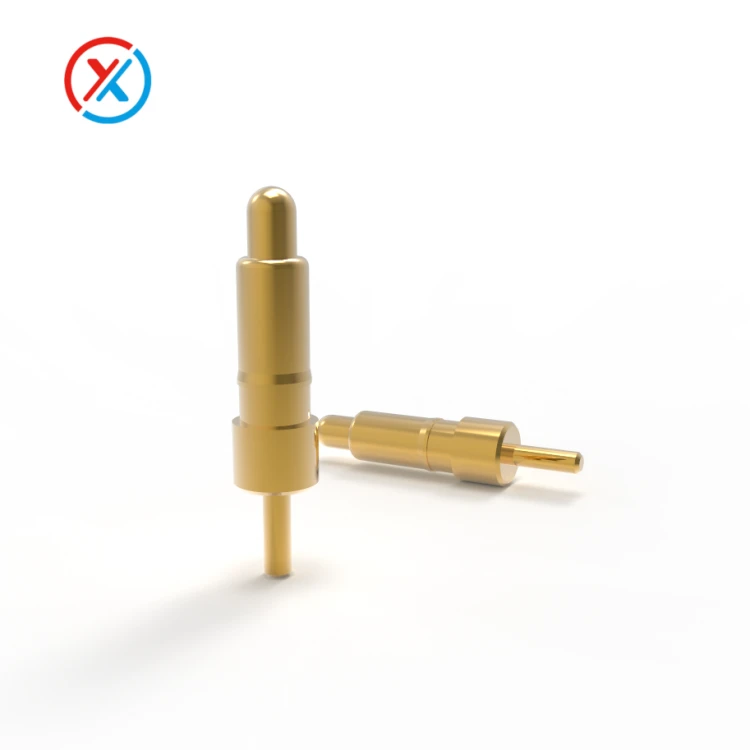
Force effects remain negligible up to approximately 10 μm total deposit thickness. Beyond 15–20 μm, the plating acts as a structural composite, potentially increasing force by 1–2% but introducing brittleness risks. For pogo pin applications, total plating rarely exceeds 5 μm (nickel plus gold), so geometric stiffening remains irrelevant. Focus instead on plating stress control and hydrogen management.
Q4: How do I specify plating requirements on technical drawings to ensure consistent spring force?
Include explicit notes stating: "Spring force measured prior to plating; post-plate force shall not deviate more than 8% from baseline." For stainless steel, add: "Mandatory hydrogen relief bake 200–230°C for 2–4 hours within 4 hours of plating completion." For beryllium copper, specify: "No thermal treatment above 120°C permitted after age hardening." When submitting custom spring designs for manufacturing, provide your force tolerance windows and environmental exposure requirements so process engineers can optimize plating parameters accordingly.


