


For connector applications, the commonly referenced IP protection standard is IEC 60529, not IEC 60668. IEC 60529 defines the IP Code and specifies standardized protection tests against water and solid foreign objects. For road-vehicle applications, ISO 20653 uses the same basic IP framework and adds special requirements identified by the letter K.
1. Start with the required IP protection level
The first step is to determine what type of water exposure the connector must withstand.
Different applications may require different levels of protection. A connector exposed to rain may have different requirements from one installed underneath an E-bike, inside industrial equipment, or on a vehicle that is regularly cleaned with high-pressure water.
Typical requirements include:
IPX5 for protection against water jets
IPX6 for stronger water jets
IPX7 for temporary immersion
IPX8 for continuous immersion under specified conditions
IPX9 for high-temperature, high-pressure water jets
IPX9K for road-vehicle applications involving high-pressure and high-temperature cleaning conditions
It is important not to treat IP67, IP68, or IP69K as simple labels. Each rating corresponds to a specific test method and test condition. In addition, the IP rating does not automatically define resistance to chemicals, vibration, corrosion, or long-term seal ageing. Those characteristics normally require additional testing.
2. Check the connector before waterproof testing
A good waterproof test begins before the water is introduced.
The connector should first be inspected for dimensional defects, assembly problems, damaged seals, cracks, gaps, incomplete overmolding, and abnormal contact conditions.
For a Pogo Pin or magnetic connector, particular attention should be paid to:
Sealing around the connector housing
Gaps between the mating components
Cable and wire exit areas
Pogo Pin contact openings
Magnetic connector mating surfaces
O-rings, gaskets, and sealing compounds
Plastic housing deformation
Contact alignment and spring movement
Electrical characteristics should also be recorded before testing. Depending on the application, this may include contact resistance, insulation resistance, dielectric withstand, continuity, and functional testing.
This provides a baseline for comparison after the waterproof test.
3. IPX9/IPX9K high-temperature and high-pressure water testing
For applications requiring resistance to aggressive water jets, IPX9 is one of the most demanding water tests within IEC 60529. ISO 20653 additionally defines IPX9K for road-vehicle electrical equipment and includes special requirements for the test conditions.
For the standardized IPX9 test, small enclosures are subjected to high-temperature water jets from specified directions. Typical conditions include approximately 80 ± 5°C water, a flow rate of about 14–16 L/min, and water pressure in the range of approximately 8–10 MPa. The test uses spray positions around 0°, 30°, 60°, and 90°, with 30 seconds of exposure at each position for small specimens.
The purpose is not simply to determine whether water reaches the outer surface. The test challenges the entire sealing system with high water pressure and elevated temperature, which can reveal weaknesses around joints, seals, cable exits, connector interfaces, and housing structures.
For vehicle-related applications, ISO 20653:2023 specifically addresses IPX9K and notes that the K requirements are special road-vehicle requirements beyond the basic IEC 60529 framework.
4. Pay attention to the sealing structure
Waterproof performance is usually determined by the weakest sealing point rather than by the connector's main body alone.
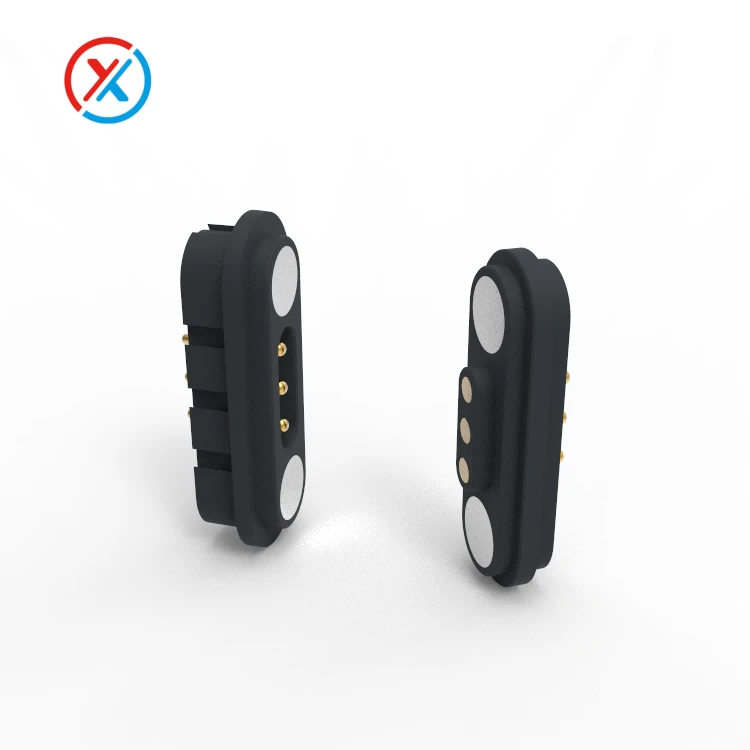
For a magnetic Pogo Pin connector, engineers should evaluate the complete structure, including the housing, magnetic components, Pogo Pin openings, mating interface, cable outlet, and surrounding mounting surface.
The sealing structure may use:
Silicone or rubber sealing rings
Gaskets
Overmolded structures
Sealing adhesives
Waterproof potting
Press-fit or interference-fit structures
Multi-stage sealing interfaces
The choice depends on operating temperature, pressure, chemical exposure, mechanical movement, expected service life, and manufacturing requirements.
For connectors used outdoors, the seal also needs to accommodate dimensional changes caused by temperature variation. A connector that passes a room-temperature water test may still experience leakage after repeated heating and cooling if the sealing interface is not properly designed.
5. Waterproof testing should be followed by electrical inspection
Passing the water test does not necessarily mean that the connector has maintained its electrical performance.
After testing, the connector should be inspected for visible water ingress, condensation, corrosion, contamination, seal displacement, housing deformation, and other abnormalities.
Electrical testing can then be performed according to the product requirements. Common checks include:
Contact resistance
Insulation resistance
Dielectric withstand
Electrical continuity
Signal transmission
Charging or power-transfer performance
Functional operation
For Pogo Pin connectors, contact resistance is particularly important because moisture or contamination around the contact area can affect electrical stability even when the connector still appears mechanically intact.
6. Waterproof testing is not the same as chemical-resistance testing
One point that is often misunderstood is the use of chemicals during waterproof testing.
Standard IPX9 testing is primarily a water-jet protection test. Chemical exposure is not automatically included simply because a connector is being tested for IPX9/IPX9K protection. IEC 60529 also indicates that protection outside the specified water-test conditions or against solvents may require separate consideration.
If a connector will be exposed to cleaning agents, salt water, oil, coolant, detergents, or other chemicals, additional chemical compatibility and corrosion testing should be established according to the actual application.
This is particularly important for automotive, marine, industrial automation, outdoor equipment, and cleaning-intensive applications.
7. Add mechanical and environmental tests when necessary
A waterproof connector may pass an IP test when new but fail after repeated mechanical or environmental stress.
For this reason, a complete reliability program may combine waterproof testing with:
Vibration testing
Mechanical shock testing
Mating-cycle testing
Temperature cycling
High- and low-temperature exposure
Salt spray or corrosion testing
Cable pull testing
Seal ageing testing
Pressure or leak testing
Electrical performance testing after environmental exposure
For example, an E-bike connector may experience vibration, rain, mud, repeated temperature changes, and frequent module removal. Testing only with stationary water spray cannot fully reproduce this operating environment.
The test sequence should therefore be designed around the customer's actual failure risks rather than using one waterproof test as the only acceptance criterion.
8. Air-tightness and pressure testing can identify sealing defects
For products requiring a higher level of sealing control, air-leak testing can be used as an additional inspection method.
Unlike a water test, an air-leak test can help identify small sealing defects before they become visible water-ingress failures. This is useful during production because it can provide a faster method for screening large quantities of components.
For mass production, the appropriate approach may be to combine process inspection, air-leak testing, electrical testing, and periodic IP verification. This creates a more practical quality-control system than relying exclusively on destructive or time-consuming environmental testing.
9. Connector manufacturing accuracy directly affects waterproof performance
Waterproof performance is closely related to dimensional accuracy.
A sealing groove that is too deep, a housing that is slightly oversized, an incorrectly positioned contact hole, or an uneven mating surface can change the compression of the sealing element and create a leakage path.
For this reason, precision machining is often required for connector housings, locating components, metal shells, sealing interfaces, test fixtures, and other non-standard mechanical parts.
When a standard component does not fit the equipment structure, these parts can be manufactured according to customer drawings or 3D models. Single-piece and small-batch precision machining are also suitable for prototype development, customized equipment, and specialized production systems.
For packaging machinery and other special-purpose equipment, dedicated non-standard components can likewise be manufactured from customer drawings, with the material, dimensions, tolerances, surface treatment, and production quantity determined according to the equipment requirements.
10. A practical waterproof verification process
A reliable connector waterproof evaluation can therefore follow a complete sequence:
Define the required IP protection level and application environment.
Confirm the connector's mechanical and electrical specifications.
Inspect dimensions, seals, housing, contacts, and assembly quality.
Record baseline electrical performance.
Perform the required IP water test.
Conduct visual and internal inspection after testing.
Repeat electrical and functional testing.
Add air-leak, pressure, vibration, temperature, corrosion, or chemical tests when required.
Compare pre-test and post-test results.
Analyze any leakage or electrical degradation and improve the connector structure or manufacturing process.
This approach provides much more useful information than simply stating that a connector is "waterproof."
FAQ
What standard is used for waterproof testing of connectors?
IEC 60529 is the primary international standard for IP protection classification. It defines standardized tests for protection against solid objects and water. For road vehicles, ISO 20653 provides the IP framework and includes special K-designated requirements such as IPX9K.
Is IPX9K the same as IP68?
No. IP68 is associated with continuous immersion under specified conditions, while IPX9/IPX9K addresses high-temperature, high-pressure water jets. A connector may require more than one IP designation if it needs to withstand different types of water exposure.
Does passing an IPX9 test prove that a connector is resistant to chemicals and vibration?
No. IPX9 testing evaluates protection against the specified high-temperature water-jet conditions. Chemical exposure, vibration, corrosion, thermal cycling, and long-term ageing generally require additional tests based on the intended application.
Can non-standard connector components be precision-machined according to drawings?
Yes. When standard components cannot meet the required dimensions or installation structure, customized housings, mounting components, sealing interfaces, positioning parts, and test fixtures can be produced from customer drawings or 3D models. Single-piece and small-batch precision machining can also be used for specialized packaging machinery components and other non-standard equipment parts.


