


Magnetic Pogo Pin connectors are increasingly suitable for modular electrical connections in E-bike systems. Unlike conventional wired plugs that require manual alignment and mechanical insertion, a magnetic connector combines magnetic guidance with spring-loaded contacts to simplify docking while maintaining electrical continuity.
In an E-bike, this type of connector can be considered for battery interfaces, displays and controllers, sensors, lighting modules, charging interfaces, and removable accessories. Its value is not simply the magnetic connection itself. The real engineering advantages come from combining compact Pogo Pin contacts, controlled contact force, magnetic positioning, environmental sealing, and a mechanical structure designed around the vehicle's vibration and outdoor operating conditions.
Battery connection
The battery is one of the most demanding areas for an E-bike connector because the interface may need to carry both power and low-voltage signals.
A magnetic Pogo Pin interface can be designed between a removable battery module and the vehicle-side electrical system. The magnets provide guidance during installation, while the spring-loaded contacts compensate for small dimensional variations and maintain contact pressure after mating.
Depending on the system architecture, separate contacts can be allocated for power, battery monitoring, temperature feedback, communication, or identification signals. This allows several electrical functions to be integrated into one compact interface instead of using multiple independent connectors.
For removable battery systems, the mechanical structure is particularly important. The magnetic force should not be treated as the only retention mechanism. Vibration, impact, accidental pulling, and movement of the battery can introduce forces that are much greater than those present during a stationary connection. A properly designed interface may therefore combine magnetic positioning with mechanical locating features or secondary retention.
Environmental protection is another consideration. Battery interfaces mounted on the exterior or lower section of an E-bike can be exposed to rain, road splash, mud, and dust. Sealing structures and appropriate IP protection should be selected according to the actual installation position and test requirements.
Display and controller connections
Displays, control panels, and handlebar-mounted electronic modules are another practical application for magnetic Pogo Pin connectors.
A display assembly may require power together with communication or control signals. A multi-contact Pogo Pin interface can integrate these connections into a small footprint, reducing the number of separate wires and connectors inside the module.
The spring-loaded contact structure can also help accommodate small assembly tolerances. This is useful when the display or controller is mounted on a component that experiences continuous vibration during riding.
A modular connector also simplifies maintenance. If the display needs to be replaced, the technician can disconnect the module without repeatedly manipulating a conventional plug deep inside the vehicle structure.
The connector layout should nevertheless be designed carefully. Power and signal contacts should be arranged to reduce the possibility of incorrect mating, accidental shorting, or interference between high-current and low-level signal paths.
Motor and sensor connections
Motor systems involve substantially different electrical requirements from low-power sensor circuits, so the connector must be selected according to the actual current profile rather than simply using a generic Pogo Pin.
For higher-current applications, multiple contacts can be connected in parallel to distribute the electrical load and reduce the current carried by an individual contact. Contact diameter, spring force, contact resistance, plating system, temperature rise, and available mating space all need to be evaluated together.
Sensor connections have a different priority. Torque sensors, speed sensors, position sensors, and other electronic sensors generally require stable low-level signal transmission rather than high current capacity. Contact resistance stability and protection against contamination become more important in these applications.
Gold-plated contact surfaces are commonly considered where oxidation resistance and stable contact performance are required. However, plating thickness and material should be determined according to the expected current, mating cycles, environmental exposure, and cost requirements rather than treating thicker plating as universally better.
Magnetic charging interfaces
Charging is one of the most intuitive applications for magnetic Pogo Pin connectors on an E-bike.
The magnetic structure can guide the charging cable toward the correct position, reducing the alignment effort required from the user. This can be particularly useful when the charging interface is located in a narrow or difficult-to-access area.
A charging interface can also be designed without a conventional deep plug socket. When properly sealed, this can simplify external waterproofing and reduce the number of openings exposed to rain and dust.
For charging applications, however, the connector must be evaluated according to the complete charging system. Rated current, contact resistance, temperature rise, cable specification, charging duration, and worst-case environmental temperature should all be considered.
The connector should also be designed to prevent unintended separation during charging while allowing a controlled release if the cable is accidentally pulled. The appropriate balance between magnetic retention and mechanical retention depends on the location and function of the charging port.
Lighting and removable accessories
E-bike lighting systems, navigation devices, auxiliary displays, cameras, and other accessories can benefit from compact modular electrical interfaces.
A magnetic connector allows an accessory to be electrically connected while also simplifying installation and removal. This is useful for products that are frequently detached for storage, transportation, maintenance, or security reasons.
For example, a removable front light may require only a small number of power contacts. Instead of routing a separate cable through the frame every time the light is installed, a magnetic Pogo Pin interface can provide the electrical connection at the mounting position.
The same concept can be extended to other low-power accessories, provided that the electrical load, mechanical retention, environmental exposure, and mating frequency are within the connector's specified operating range.
Removable handlebars and modular structures
Some E-bike designs use folding or modular mechanical structures. These structures create additional requirements because the electrical connection has to accommodate repeated movement while maintaining reliable contact.
A Pogo Pin interface can provide an electrical connection between two modules without requiring a conventional cable plug. When the mechanical module is separated, the electrical path is automatically disconnected.
This approach can reduce exposed wiring and make modular assembly more convenient. However, the connector should not be expected to compensate for poor mechanical design. The mating surfaces need sufficient alignment control, and the connector should not be used as a structural load-bearing component unless it has been specifically designed for that purpose.
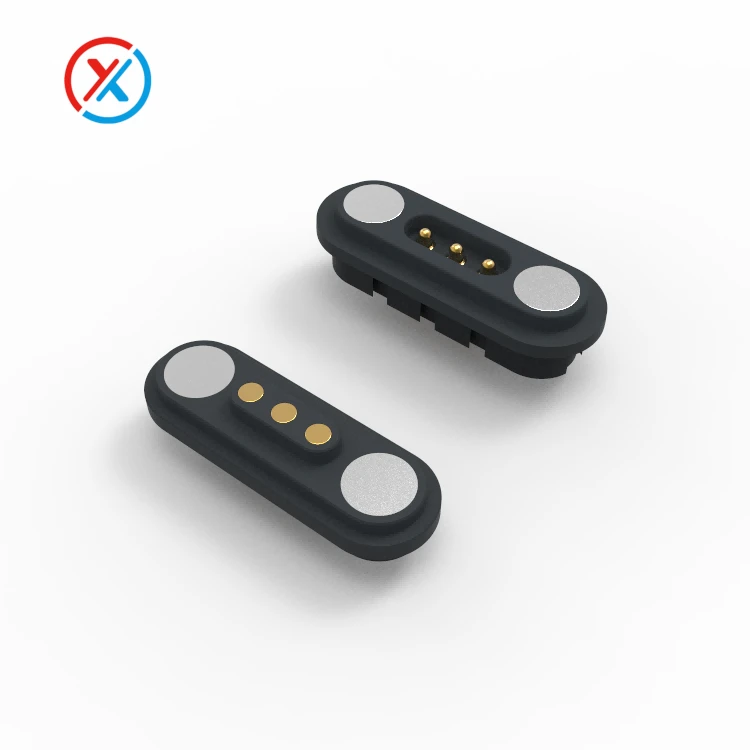
Key design considerations for E-bike magnetic connectors
Retention and anti-separation
An E-bike is exposed to continuous vibration and occasional shock. Magnetic force therefore needs to be evaluated under dynamic conditions rather than only under static pull testing.
For critical power connections, secondary positioning or retention features can be incorporated into the housing. Locating bosses, grooves, mechanical stops, or locking structures can help prevent lateral movement and excessive loading on the Pogo Pin contacts.
The magnetic force should also be balanced carefully. Excessive attraction can increase assembly difficulty and mechanical stress, while insufficient force can result in unintended separation.
Waterproof and dust protection
Outdoor E-bike applications commonly expose connectors to water, mud, dust, and cleaning processes. IP67 or IP68 protection may be appropriate for some exposed interfaces, but the actual requirement should be established from the installation environment and test conditions.
It is also important to distinguish between the connector's rated IP protection and the protection of the complete E-bike assembly. Seals, housing interfaces, cable exits, mounting surfaces, and surrounding structures can all affect the final waterproof performance.
Current capacity
High-current applications require more than simply selecting a connector with a nominal current rating.
The electrical design should consider contact resistance, current distribution, contact diameter, spring force, plating, temperature rise, and the duration of continuous or peak current.
For higher current requirements, several Pogo Pin contacts may be connected in parallel. This can distribute the load and reduce the electrical stress on individual contacts, but the current-sharing design must be properly controlled.
Contact plating and service life
The contact surface is directly exposed to mechanical mating and environmental contamination. Appropriate plating can improve resistance to oxidation, corrosion, and contact wear.
The required plating system depends on the application. A frequently mated accessory may require a different surface treatment from a connector that remains permanently assembled. Similarly, an outdoor connector exposed to moisture and salt spray may require more demanding surface protection than an indoor module.
Mechanical life should also be evaluated together with electrical life. A connector may remain mechanically functional while its contact resistance has already increased because of wear, contamination, or plating damage.
Mechanical tolerance and installation
Magnetic connectors are particularly sensitive to the relationship between the magnet, Pogo Pin, housing, and mating surface.
The contact stroke must provide enough compression to maintain reliable contact without continuously operating close to the mechanical limit of the spring. The housing should control lateral movement so that the Pogo Pin is not subjected to excessive side loading.
For non-standard E-bike structures, mounting brackets, locating plates, support components, and other mechanical parts may need to be manufactured around the selected connector. Drawing-based customization can be used when standard components do not match the available installation space or interface geometry.
The same precision machining capability can also be applied to dedicated non-standard components for packaging machinery. Based on customer drawings or 3D models, individual parts or small batches can be manufactured to the required dimensions, tolerances, materials, and surface-treatment specifications rather than forcing the equipment design to conform to an existing standard part.
Why magnetic Pogo Pin connectors are attractive for E-bike designs
The main advantage of this solution is the combination of electrical connectivity and mechanical convenience.
Magnetic guidance makes docking easier. Spring-loaded contacts compensate for limited dimensional variation. A compact contact arrangement helps save installation space. Proper sealing can improve environmental resistance. Modular interfaces can also make accessories and electronic modules easier to replace.
However, these advantages only become meaningful when the connector is matched to the actual application. Battery power connections, sensor interfaces, charging ports, and accessory contacts have different electrical and mechanical requirements.
For E-bike manufacturers, connector selection should therefore begin with the complete operating environment and system requirements rather than choosing a magnetic connector based only on appearance or nominal current.
FAQ
Can magnetic Pogo Pin connectors be used for E-bike battery connections?
Yes, they can be considered for certain battery interfaces, particularly where compactness, modular assembly, or magnetic docking is required. The design must account for the battery voltage, continuous and peak current, vibration, retention, contact resistance, and environmental protection.
Are magnetic Pogo Pin connectors waterproof enough for outdoor E-bikes?
Some designs can achieve IP67 or IP68 protection, but the rating applies to a specific connector structure and test condition. The complete installation must also be sealed correctly. Connector housing, cable exits, mating surfaces, and mounting structures can all affect the final waterproof performance.
How can a magnetic Pogo Pin connector carry higher current?
Higher-current designs can use larger contacts, optimized contact springs, suitable conductive materials and plating, or multiple Pogo Pins connected in parallel. The actual current capability should be determined through electrical and thermal evaluation rather than relying only on the number of pins.
Can the connector structure and related mechanical parts be customized?
Yes. When a standard connector does not match the E-bike's available space or mounting structure, the housing, locating features, brackets, mounting plates, and related precision components can be developed around the required interface. For specialized equipment such as packaging machinery, dedicated non-standard parts can also be precision-machined according to customer drawings for single-piece or small-batch production.


