


When specifying magnetic connectors for industrial packaging equipment, engineers frequently encounter premature magnetic force degradation that cannot be solved by surface treatment improvements. The root cause lies in fundamental material science: thermal resistance in permanent magnets derives from specific alloy formulations and sintering protocols, not plating or coatings. Understanding these metallurgical distinctions prevents connector failures in heat-sealing, sterilization, and high-temperature processing environments.
Sintered NdFeB: The Industry Standard
Most high-temperature magnetic connectors utilize sintered neodymium-iron-boron (NdFeB) magnets manufactured through powder metallurgy. The production sequence begins with vacuum melting of neodymium, iron, and boron, with critical additions of dysprosium and terbium for high-temperature grades. These heavy rare earth elements enhance coercivity-the magnet's resistance to demagnetization-without which standard NdFeB rapidly loses magnetic strength above 80°C.
The manufacturing process involves hydrogen decrepitation to brittle the alloy, followed by jet milling to achieve micron-sized magnetic particles. These particles undergo magnetic field alignment during compression molding, orienting the crystalline structure for optimal magnetic performance. Subsequent vacuum sintering at approximately 1050°C densifies the material, while precise two-stage tempering establishes the coercivity grade. This thermal processing determines whether the final magnet withstands 120°C or 220°C continuous exposure.
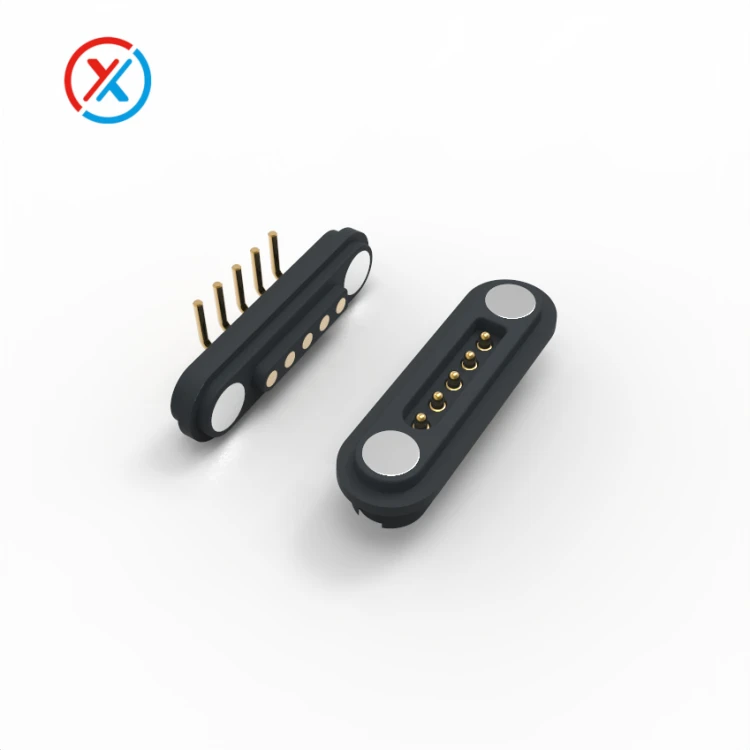
Post-sintering operations include wire electrical discharge machining or grinding to achieve dimensional specifications-typically ring geometries for connector applications. Electroless nickel-copper-nickel plating or epoxy coatings provide corrosion protection, though these surface treatments offer no thermal enhancement. Final magnetization occurs via pulsed magnetic fields after assembly integration.
Thermal Classification of NdFeB Grades
Standard consumer-grade magnets (N35, N42) operate reliably only to 80°C, making them unsuitable for surface-mount technology reflow processes or industrial heating environments. High-temperature variants follow a letter designation system:
M grade: 100°C maximum continuous
H grade: 120°C maximum continuous
SH grade: 150°C maximum continuous
UH grade: 180°C maximum continuous
EH grade: 200°C maximum continuous
AH grade: 220°C maximum continuous (commercial NdFeB limit)
These ratings represent continuous operating temperatures, not transient peaks. Exceeding specified limits causes irreversible magnetic flux loss. While NdFeB's Curie temperature (complete magnetic loss) occurs at 310–340°C, significant degradation begins well below this threshold-typically at 70–80% of the Curie point depending on alloy composition.
SmCo: The Extreme Temperature Solution
For continuous exposure above 220°C, samarium cobalt (SmCo) magnets become necessary. These alloys, available in SmCo5 (1:5 ratio) and Sm2Co17 (2:17 ratio) formulations, utilize powder metallurgy similar to NdFeB but inherently maintain coercivity at elevated temperatures without heavy rare earth additions.
SmCo magnets operate continuously at 250–350°C, with some grades tolerating brief excursions higher. They exhibit superior thermal stability-magnetic flux variation remains under 0.1% per 100°C temperature change compared to NdFeB's 0.5–1.0%. However, this performance commands premium pricing: SmCo costs approximately 3–5 times equivalent NdFeB, delivers roughly 70% of the magnetic energy product, and presents machining challenges due to extreme brittleness.
System-Level Thermal Considerations
Selecting a high-temperature magnet solves only part of the thermal management challenge. In magnetic connector assemblies, the complete component stack must withstand equivalent temperatures. Beryllium copper contact springs may retain elasticity to 120°C but lose spring force rapidly beyond this threshold. Liquid crystal polymer (LCP) or polyphenylene sulfide (PPS) housings maintain dimensional stability to approximately 220–260°C, while standard nylon or PBT plastics deform significantly above 180°C. Adhesive systems similarly require high-temperature epoxy or silicone formulations.
For packaging machinery applications involving steam sterilization, hot-fill sealing, or thermal transfer printing, specify EH-grade NdFeB as the baseline. Where temperatures exceed 200°C continuously-such as in aseptic packaging heat exchangers or industrial dryer environments-transition to SmCo magnets despite the magnetic force penalty. The alternative involves accepting larger magnet volumes to compensate for reduced energy product.
Frequently Asked Questions
Q1: Can I improve magnet temperature resistance by specifying thicker nickel plating or epoxy coating?
No. Surface treatments exclusively address corrosion protection and mechanical chipping. Thermal resistance derives from the intrinsic coercivity established during alloy formulation and sintering heat treatment. A standard N42 magnet with heavy gold plating still demagnetizes irreversibly at 85°C. Specify EH or AH grade material for high-temperature requirements.
Q2: What happens if my application briefly exceeds the rated maximum temperature?
Brief transient excursions above rated temperature cause partial irreversible loss proportional to temperature excess and duration. A 10-minute exposure at 230°C on an EH-grade (200°C rated) magnet might cause 5–15% flux loss. Recovery does not occur upon cooling. For applications with unpredictable thermal spikes, incorporate safety margins of 20–30°C below rated maximums.
Q3: How do I verify that received magnets meet specified temperature grades?
Request intrinsic coercivity (Hcj) test reports from your supplier. EH-grade NdFeB requires Hcj ≥ 30 kOe (2400 kA/m), while AH-grade requires Hcj ≥ 35 kOe (2800 kA/m). Accelerated aging tests at rated temperature for 100–1000 hours provide empirical verification. For critical applications, we perform batch sampling and thermal cycling verification on custom magnet assemblies, ensuring delivered components match specified thermal performance parameters.
Q4: My connector requires both high temperature resistance and strong magnetic force. What are my options?
Above 200°C, you face a fundamental trade-off. Options include: (1) Accepting reduced force with SmCo and enlarging magnet volume or reducing air gap; (2) Implementing thermal isolation-mounting magnets remotely from heat sources with high-temperature plastic or ceramic standoffs; (3) Active cooling integration for the connector housing. For new designs, send us your thermal environment specifications and mechanical drawings. We support custom fabrication of complete magnetic connector assemblies from client designs, optimizing material selection and geometry to achieve required retention forces within your thermal constraints.


