


A battery connector provides an electrical path between the battery assembly and the device. Depending on the design, it may also carry identification, temperature-sensing, or control signals. Those contacts transmit information to the relevant electronics; the connector itself does not normally manage battery charging or energy consumption.
Its contribution to efficiency begins with the conductive path. Resistance in the contacts, terminations, wires, flexible circuits, and PCB connections causes voltage drop and heat.
Resistive power loss follows the relationship P = I²R. At the same current, reducing resistance reduces the power dissipated in that path. The practical effect depends on the operating current, duty cycle, and proportion of total system losses attributable to the connection.
A lower-resistance connector should therefore not be assigned a fixed battery-runtime improvement without system measurements. Its benefit needs to be evaluated in the device's actual operating pattern.
Initial resistance is only part of the requirement. Contact force, surface condition, retention, and contamination can change performance over time. A connection that starts with low resistance but deteriorates during service may lose its thermal and electrical advantage.
For spring-loaded battery interfaces, the installed compression should remain within the specified working range. The housing and supports must control alignment and prevent excessive movement. Other contact constructions require equivalent attention to their engagement and retention conditions.
Miniaturization can help fit a connector into a compact enclosure, but reducing dimensions introduces tradeoffs. Smaller conductive sections can increase resistance, while reduced spacing can place greater demands on insulation, alignment, and manufacturing control.
The complete installation should be considered. A small connector may still require a carrier, reinforcement, mounting hardware, or additional PCB area. Its contribution to product size and weight should be assessed with those supporting parts included.
Multiple functions can sometimes share one connector assembly. Power, identification, and control contacts may be arranged together where the electrical architecture permits. This can simplify routing or assembly, but the layout must preserve suitable spacing, signal behavior, and current capacity.
Material selection should follow the function of each component. Conductive contacts need an appropriate balance of conductivity, strength, surface stability, and manufacturing suitability. Insulators need suitable electrical, thermal, and dimensional properties.
A material change should be evaluated against the existing design under comparable conditions. An alloy that machines more easily may improve production yield but have different conductivity. A tougher housing material may alter molding behavior or assembly fit. The finished product determines whether the change is useful.
Plating also involves a balance between performance and material use. Functional contact surfaces need sufficient coverage and wear allowance. Other regions may have different requirements, particularly where soldering or mechanical retention is involved.
Selective plating can reduce precious-metal use when the part geometry and process support it. The assessment should include processing complexity, inspection, reject rates, and durability. Reducing coating consumption is useful only if the resulting finish continues to meet the application requirements.
| Development objective | Possible design approach | Evidence to assess |
|---|---|---|
| Lower electrical loss | Improve conductive geometry and maintain stable contact | Resistance, voltage drop, and temperature under representative load |
| Longer service life | Control contact force, wear, contamination, and retention | Performance after relevant cycling and environmental exposure |
| Lower material consumption | Optimize dimensions and coating locations | Material use per acceptable finished assembly |
| Reduced production waste | Improve process consistency and dimensional control | Yield, scrap, and rework records |
| Easier maintenance | Provide accessible, replaceable interfaces where practical | Service procedure, replacement scope, and post-service performance |
| Supported environmental claims | Define the claimed improvement and comparison basis | Relevant material, process, or lifecycle records |
Manufacturing consistency matters because rejected and reworked parts consume resources without delivering an acceptable product. Clear drawings, realistic tolerances, stable processes, and effective inspection can help reduce that waste.
Inspection should focus on the features controlling performance. These may include contact dimensions, finished coating thickness, engagement depth, termination quality, and insulation spacing. Automated equipment can assist production, but automation alone does not establish quality or environmental improvement.
Repairability provides another opportunity. A separable battery connection can support assembly and service where the product is designed for it. The connector must be accessible, correctly oriented, and capable of meeting its requirements after the expected service operations.
This does not make every battery assembly suitable for user replacement. The product design and service procedure determine who can perform the work and how the completed assembly is verified.
Environmental claims should distinguish different properties. Restricted-substance compliance, recyclability, energy efficiency, and carbon emissions are separate considerations. Evidence for one does not automatically establish the others.
For example, a recyclable metal may be difficult to recover from a permanently bonded mixed-material assembly. Similarly, a material declaration does not demonstrate that a manufacturing process uses less energy or produces fewer emissions.
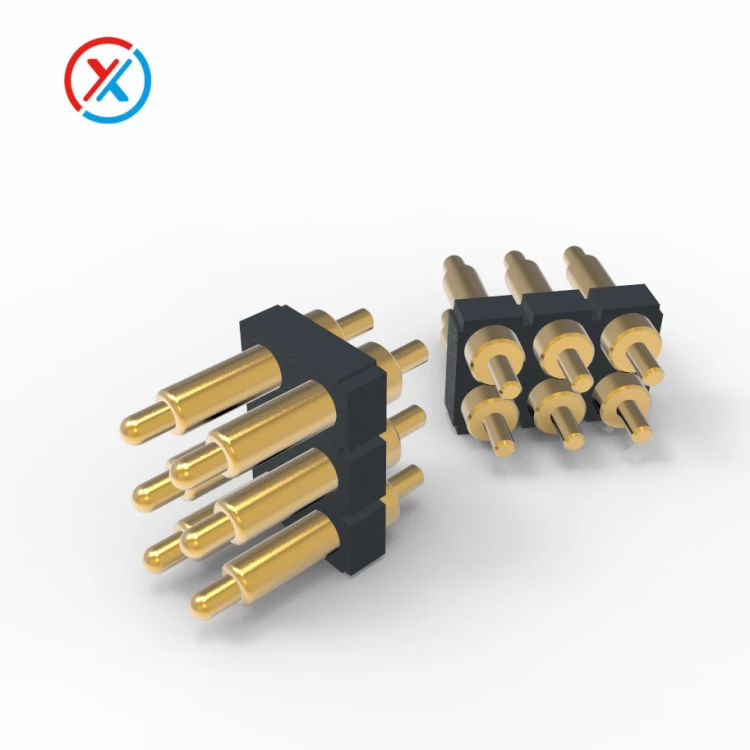
For custom pogo pin battery interfaces, XINTENG can work from customer drawings to coordinate contacts, carriers, mating parts, working compression, mounting, and terminations. Samples or small-batch assemblies can be evaluated against the proposed electrical, mechanical, and environmental requirements.
The development brief should identify continuous and peak currents, voltage, installation space, thermal conditions, retention, expected service cycles, and acceptance limits. These details help establish where changes can produce a measurable improvement.
Approved drawings, materials, finishes, inspection criteria, and test results should remain linked to the evaluated configuration. Later changes can then be assessed against the same performance and environmental objectives.
1. Can a battery connector reduce device power consumption?
Reducing resistance can lower losses in the connection. The effect on total consumption or battery runtime depends on the device's current profile and other system losses, so it requires measurement.
2. Is a smaller battery connector more environmentally friendly?
Not necessarily. Compare material use, supporting components, manufacturing yield, electrical loss, durability, and repairability for the complete assembly.
3. Does material compliance prove that a connector is energy-efficient?
No. Material compliance and energy efficiency address different properties. Efficiency requires electrical and thermal evidence under defined operating conditions.
4. What information is needed for a custom battery-interface project?
Provide drawings, current and voltage requirements, installation dimensions, thermal conditions, mounting details, expected service operations, and acceptance criteria. Existing test results can help identify where redesign would be useful.


