


In connector and cable assemblies, ferrite can serve two very different purposes. A permanent ferrite magnet can provide magnetic attraction, while a soft ferrite core can help control unwanted electrical noise. These materials are selected for different magnetic behavior and are not interchangeable.
Ferrites are generally described as magnetic materials, although many technically exhibit ferrimagnetism: opposing magnetic moments do not completely cancel, leaving a net magnetization. For component selection, the more useful distinction is how readily the material magnetizes, how much magnetization it retains, and how it behaves at the intended frequency and temperature.
Their relatively high electrical resistivity helps reduce eddy-current losses compared with conductive magnetic metals. This makes suitable ferrite grades useful in alternating magnetic fields. It does not mean that every ferrite performs well at every frequency.
Permeability, magnetic loss, saturation behavior, and temperature dependence all vary with the formulation. The material must be selected for its actual operating conditions.
| Material group | Main magnetic characteristic | Typical applications |
|---|---|---|
| Soft ferrite | Magnetizes and reverses magnetization relatively easily | Transformer cores, inductors, common-mode chokes, and EMI suppression |
| Hard ferrite | Retains magnetization and resists demagnetization | Permanent magnets in motors, loudspeakers, sensors, and magnetic retention assemblies |
| Microwave ferrite | Provides a controlled magnetic response at microwave frequencies, often with magnetic bias | Circulators, isolators, and other specialized RF components |
"Soft" and "hard" describe magnetic behavior. They do not describe whether the ceramic is flexible or mechanically tough. Both types can be brittle and require suitable handling and mounting.
Soft ferrites are useful where the magnetic field changes repeatedly. Manganese-zinc and nickel-zinc ferrites are established material families, but selecting between them requires more than comparing their names.
A transformer core needs acceptable magnetic loss and saturation performance under its operating waveform. A suppression core needs an impedance characteristic suited to the unwanted noise. Different grades within the same material family can therefore serve different purposes.
High permeability is not automatically the best choice. Designers also need to consider frequency, magnetic flux density, temperature, DC bias where applicable, and core dimensions. A material that performs well under a small laboratory excitation may behave differently in a loaded circuit.
Ferrites are also used in power conversion. Their limitations cannot be described simply as "unsuitable for high power." The practical design depends on switching frequency, magnetic losses, winding construction, core size, cooling, and the permitted temperature rise.
A ferrite sleeve or split core fitted around a cable uses magnetic impedance to influence unwanted currents. Its effect varies with frequency and the way conductors pass through it.
In a common-mode arrangement, supply and return conductors pass through the same core. Their opposing normal load currents largely cancel magnetically, while common-mode currents can produce net magnetic flux that the core acts upon.
This is different from using a ferrite component in series with an individual power or signal conductor. The circuit arrangement determines which currents the component affects.
Core material, dimensions, cable routing, placement, and any gap between split-core halves influence suppression performance. The relevant evidence is the component's impedance characteristic and its behavior in the assembled equipment.
Adding a ferrite core does not automatically solve an interference problem. Grounding, shielding, cable construction, and noise-source behavior still matter. For a data cable, testing should also confirm that the selected arrangement preserves the intended communication performance.
Hard ferrites are permanent-magnet materials. Commercial formulations commonly include strontium or barium ferrite. After magnetization, they retain a magnetic field and can be used for attraction, position sensing, or motor operation.
"Permanent" does not mean unaffected by temperature or external magnetic fields. The material grade, geometry, magnetization direction, and magnetic circuit determine how the magnet performs.
For a magnetic connector, holding force should be evaluated in the installed assembly. Air gaps, housing thickness, alignment, mating steel or magnets, and the force of compressed pogo pins all affect the result.
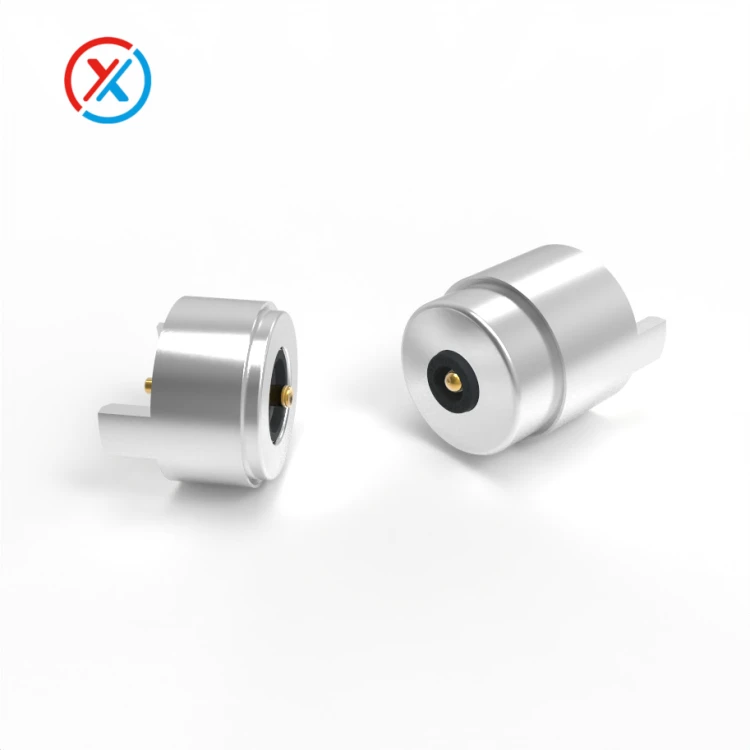
A ferrite magnet may be suitable where sufficient space is available and its magnetic characteristics meet the retention requirement. A compact connector may instead require another magnet material. Substituting ferrite for a rare-earth magnet usually requires a review of the magnetic circuit and available volume.
Permanent magnets and magnetic cores also perform different jobs inside a motor. Hard ferrite may form the permanent magnets, while parts carrying changing magnetic flux generally use soft magnetic materials, such as electrical steel. These functions should not be combined into one material requirement.
Microwave ferrites form a more specialized group. Under appropriate magnetic bias, their response can enable nonreciprocal behavior, allowing a device to treat microwave signals differently according to their direction of travel. This supports components such as circulators and isolators.
Their selection involves microwave loss, magnetic behavior, bias conditions, and operating frequency. A general-purpose cable suppression core cannot be assumed to provide the properties required by an RF component.
Other ferrite classifications describe particular characteristics. Square-loop materials have magnetic hysteresis behavior suited to switching and historical magnetic-core memory applications. Magnetostrictive materials change dimensions under magnetization and can be used in electromechanical conversion. These are functional classifications rather than evidence that every ferrite belongs to a completely separate material family.
The manufacturing process helps establish the finished properties. A typical sintered ferrite component begins with controlled raw-material preparation, mixing, and milling. Depending on the process, the powder may undergo calcination before further milling, granulation, and forming.
The shaped part is then sintered under controlled thermal and atmospheric conditions. Composition, particle characteristics, forming density, temperature, and furnace atmosphere can influence the resulting magnetic properties and dimensions.
A single firing temperature is not appropriate for all ferrites. The process must match the material formulation and the required properties.
Sintering also causes dimensional changes. Where tighter finished dimensions are necessary, suitable grinding or other finishing operations may be required. Hard ferrite magnets additionally need magnetization in the specified direction and pattern.
Chemical powder-preparation methods, including coprecipitation and sol-gel processing, provide other routes to controlling composition and particle characteristics. Their use depends on the product and manufacturing requirements; they should not be treated as automatic indicators of superior component performance.
Mechanical integration is especially important because ferrite is a ceramic. Thin sections, sharp corners, excessive clamping force, and impact can cause chips or cracks. The housing should retain the part without applying uncontrolled stress.
In a cable assembly, the core holder must also accommodate the cable diameter and routing. In a magnetic connector, the magnet pocket should control position while protecting the magnet during assembly and use.
Ferrite's electrical resistivity should not be treated as proof that it provides a specified insulation barrier. Where insulation is required, the complete construction-including sleeves, housings, spacing, and other insulating features-needs to meet the electrical requirements.
For a custom connector project, the design inputs should identify:
Magnetic function: permanent attraction, sensing, power conversion, or noise suppression.
Operating conditions: temperature, frequency where relevant, electrical load, and environmental exposure.
Available space: finished dimensions, mounting arrangement, cable clearance, and permitted mass.
Performance target: holding force, magnetic response, impedance, loss, or another defined requirement.
Mechanical requirements: retention, handling, vibration, impact, and assembly sequence.
Verification method: measurement conditions, test fixtures, and acceptance limits.
Ferrite manufacturing and precision contact machining are separate processes. In a pogo pin assembly, the conductive contacts still require suitable metal materials, controlled dimensions, and appropriate surface finishes. The ferrite component serves a magnetic function alongside those contacts.
XINTENG's drawing-based customization can coordinate pogo pin contacts, connector housings, insulating carriers, mounting parts, and cable terminations around a specified magnetic component. For a cable requiring ferrite suppression, the development work also includes core placement, retention, and routing.
The ferrite grade and magnetic characteristics should be confirmed with the magnetic-material supplier. Sample evaluation can then assess the combined assembly, including electrical performance, mechanical fit, and the intended magnetic function.
Production documentation should link the approved material grade, part dimensions, magnetization details where applicable, and inspection conditions. A visually similar replacement core or magnet may behave differently, so material substitutions need an appropriate engineering review.
1. Are all ferrites permanent magnets?
No. Hard ferrites are used as permanent magnets, while soft ferrites are designed for applications involving changing magnetic fields. A cable suppression core and a ferrite retention magnet perform different functions.
2. Why are ferrite cores fitted around some cables?
They add frequency-dependent impedance that can help suppress unwanted electrical noise. Their effectiveness depends on the material, dimensions, conductor arrangement, and placement. Performance should be checked in the complete equipment.
3. Can ferrite magnets replace neodymium magnets in a magnetic connector?
They may be an option, but usually require a design review. The available volume, air gap, magnetic circuit, temperature, and required holding force determine whether ferrite is suitable. Matching the external dimensions does not guarantee equivalent attraction.
4. What information is needed to integrate ferrite into a custom connector or cable assembly?
Provide the assembly drawings, available space, intended magnetic function, operating conditions, and performance target. For permanent magnets, include magnetization direction and retention requirements. For suppression cores, identify the cable construction, relevant noise frequencies, and electrical test requirements.


