


Pogo Pin technology is well suited to these applications because its spring-loaded contact can maintain pressure against a mating pad without requiring a conventional plug-and-socket structure. Depending on the terminal design, Pogo Pins can be used for power, low-level signals, charging, or combined power and signal interfaces.
Pogo Pin as part of a smart terminal connection system
A smart terminal connection is more than the contact itself. The Pogo Pin, mating pad, housing, positioning structure, retention mechanism, PCB, and cable or power circuit all affect the final connection.
When the terminal is docked, the Pogo Pin plunger moves into the barrel and the spring generates contact force. This allows the contact to compensate for a limited amount of dimensional variation between the terminal and its mating interface.
The surrounding mechanical structure has to control the position of the two sides. If the terminal moves excessively sideways or approaches the contact at an unsuitable angle, the spring-loaded mechanism cannot compensate for the resulting mechanical load indefinitely.
For this reason, a practical smart terminal design normally defines the contact height, working compression, contact spacing, mating direction, mechanical support, and required electrical load together.
Smart home devices
Smart home equipment often needs compact electrical interfaces that can be hidden inside a small enclosure or integrated into a removable module.
A smart doorbell, for example, may use spring-loaded contacts between its main body and a mounting or charging assembly. This arrangement can reduce the need for a conventional charging port and allows the electronic unit to be detached from the mounting structure when required.
Smart cameras and other connected devices can also use Pogo Pin contacts for power or service connections. A docking structure can be designed so that the terminal reaches a defined position before the contacts are compressed.
The main engineering considerations include contact force, available installation height, current requirement, environmental exposure, and the number of expected connection cycles. If the device is installed outdoors, the Pogo Pin interface also needs to be considered together with the enclosure sealing structure. A Pogo Pin itself should not be treated as waterproof simply because the surrounding product has a sealed housing.
For compact consumer devices, the connector layout can also be customized around the available PCB area. Power contacts can be separated from signal contacts, and the number and spacing of contacts can be adjusted according to the actual circuit.
Pogo Pin applications in EV smart cockpits
Modern vehicle cockpits contain more electronic modules than traditional dashboards. Displays, control panels, sensors, lighting modules, headrest electronics, and other components may require compact interfaces that support installation and service requirements.
Pogo Pin contacts can be considered for certain modular or docking-type connections where repeated engagement and controlled positioning are part of the mechanical design.
For example, a removable display or control module can use a spring-loaded contact array to connect power and selected signal lines. The contact assembly can be positioned behind the module, leaving the visible surface free of a conventional connector opening.
The mechanical design is particularly important in automotive applications. Vehicle vibration, thermal expansion, assembly tolerance, and repeated servicing can change the relative position of the two mating interfaces. The housing and locating features therefore need to prevent excessive side loading on the Pogo Pins.
Automotive applications also require more than a nominal current rating. Engineers should evaluate contact resistance, temperature rise, vibration behavior, mating life, material compatibility, and environmental requirements under the actual operating conditions.
Pogo Pin technology can therefore be useful for selected cockpit modules, but the connector structure should be chosen according to the electrical and mechanical requirements of the specific vehicle system rather than assuming that one Pogo Pin design fits every automotive application.
Industrial mobile terminals
Industrial handheld terminals have different requirements from consumer smart devices. They may be used for long shifts, connected to docking stations repeatedly, and exposed to vibration, dust, temperature changes, or accidental mechanical loads.
A Pogo Pin docking interface allows a handheld terminal to establish power and data connections when it is placed into a cradle. The spring-loaded contacts accommodate small height differences between the terminal and dock while the mechanical guide controls the final position.
This approach is useful for warehouse terminals, vehicle-mounted displays, industrial PDAs, inspection equipment, and other portable devices that need frequent docking.
The design should pay particular attention to the mating surface. Dirt, metal particles, oxidation, or excessive wear can increase contact resistance. In industrial environments, the housing can be designed to reduce direct contamination around the contact area, while maintenance procedures can define how the contact surface is inspected and cleaned.
For vibration-sensitive equipment, electrical continuity should also be evaluated while the terminal is exposed to representative movement. Measuring contact resistance only before and after a vibration test may not reveal short interruptions that occur during operation.
Combining Pogo Pins with magnetic docking
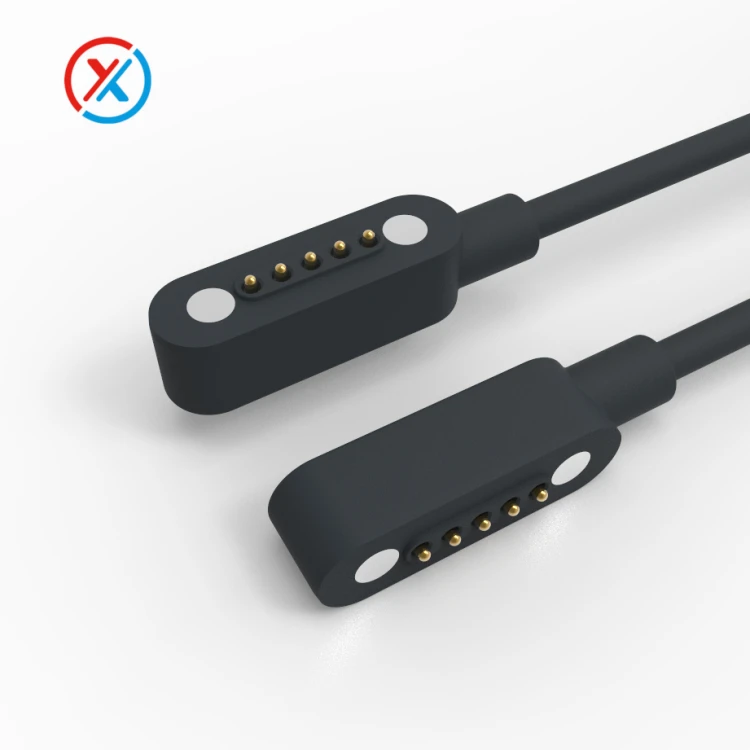
Pogo Pins are often combined with magnets when a terminal needs quick positioning without a conventional locking connector.
The magnet provides the attraction force and helps guide the two interfaces together. The Pogo Pins then provide the electrical connection after the mating surfaces reach the intended position.
This combination can be useful for charging docks, removable control panels, portable terminals, smart home accessories, and other equipment that is frequently connected and disconnected.
The magnetic force should not be considered a substitute for mechanical positioning. If the magnets provide strong attraction but the connector allows excessive lateral movement, the Pogo Pins can still experience uneven loading.
The design should therefore coordinate magnetic force, contact spring force, housing geometry, alignment features, and the required separation behavior.
Standard and customized Pogo Pin configurations
A standard Pogo Pin can be a practical choice when the required diameter, travel, spring force, contact height, current capacity, and mounting method already match the terminal design.
Smart terminal projects often have less flexibility. The PCB may have a fixed contact layout, the enclosure may provide only a small installation area, or the docking structure may require an unusual contact arrangement.
In these cases, the connector can be developed around the actual product interface. Contact quantity, pitch, housing dimensions, magnet position, cable exit direction, mounting method, and terminal height can be adjusted according to the application.
The surrounding precision parts can also be produced from customer drawings. For industrial equipment and packaging machinery, this may include connector mounting blocks, locating plates, guide sleeves, brackets, shafts, and other dedicated non-standard components. Single-piece and small-batch precision machining is suitable when a machine requires a specific geometry that is not available as a standard part.
This approach is useful when the Pogo Pin interface has to fit an existing machine structure rather than requiring the entire equipment layout to be redesigned around a catalogue component.
What should be specified before developing a smart terminal solution?
The electrical requirements should be defined first. These normally include working voltage, continuous current, peak current, signal type, contact resistance requirements, and whether power and data need to share the same interface.
The mechanical requirements then determine the appropriate Pogo Pin structure. Engineers should specify available installation height, contact spacing, working compression, mating direction, expected connection cycles, and allowable positional tolerance.
The operating environment also needs to be considered. Temperature, humidity, dust, vibration, chemical exposure, and required sealing performance can affect the choice of contact materials, plating, housing, and mechanical protection.
For a customized project, the customer's PCB drawings, enclosure dimensions, mounting references, and mating conditions provide the basis for developing the connector and related precision components.
FAQ
Where are Pogo Pins commonly used in smart terminal systems?
Typical applications include smart home devices, charging docks, industrial handheld terminals, vehicle cockpit modules, removable displays, sensors, and other equipment that requires compact spring-loaded electrical contacts.
Can one Pogo Pin interface carry both power and data?
It can, depending on the electrical design. More commonly, separate contacts are assigned to power, ground, and signal functions so that current-carrying contacts and signal contacts can be designed according to their different requirements.
Are magnetic Pogo Pin connectors suitable for industrial equipment?
They can be suitable when the equipment benefits from quick docking or controlled separation. However, vibration, contamination, magnetic retention, contact force, and mechanical positioning should be evaluated together rather than relying on magnetic attraction alone.
Can smart terminal connector components be manufactured according to customer drawings?
Yes. Standard Pogo Pins can be combined with custom housings and dedicated mechanical parts when the standard dimensions do not match the equipment. Mounting blocks, locating components, brackets, sleeves, shafts, and other non-standard precision parts can be manufactured from customer 2D drawings or 3D models, including single-piece and small-batch requirements.


