


NdFeB generally provides greater magnetic performance within a compact volume. Ferrite can be practical where more space is available and material cost is a priority. The correct choice depends on the finished connector geometry rather than the magnet material alone.
In a magnetic pogo pin connector, the magnets assist alignment and retention. The spring-loaded contacts carry power or signals. These functions must work together, but the magnet material does not independently establish the connector's electrical rating.
| Comparison | Ferrite magnets | NdFeB magnets |
|---|---|---|
| Magnetic performance | Generally lower magnetic energy density | Generally higher magnetic energy density |
| Space required | May need a larger volume to meet a given retention requirement | Can support stronger attraction within a compact envelope |
| Temperature behaviour | Often suitable for elevated-temperature applications, subject to grade and magnetic circuit | Strongly dependent on grade, magnetic circuit, and exposure conditions |
| Corrosion resistance | Generally good resistance of the magnet material itself | Bare material is susceptible to corrosion and usually needs protection |
| Mechanical properties | Brittle; edges and thin sections can chip | Also brittle and vulnerable to impact or excessive assembly stress |
| Material cost | Generally lower | Generally higher |
| Typical design fit | Space-tolerant, cost-sensitive retention interfaces | Compact charging heads, wearable interfaces, and small magnetic connectors |
For connector selection, "ferrite" means a hard ferrite permanent magnet. It should not be confused with the soft ferrite used in cable suppression cores or inductors. Those components serve a different magnetic function.
NdFeB is useful when the housing leaves little room for the magnetic system. A compact charging head for smart glasses or a wearable device may need sufficient attraction to overcome the contact springs while remaining small enough for comfortable handling.
Ferrite may require a larger magnet or a different magnetic circuit to achieve the required retention. That can be acceptable in a desktop dock or another assembly with sufficient installation space.
However, holding force cannot be predicted from volume alone. Magnet thickness, shape, pole arrangement, air gap, backing material, and the mating component all influence the result. A magnet attracting another magnet also behaves differently from one attracting a steel target.
The housing can significantly affect the effective gap. Plastic between the magnetic faces, recessed mounting, adhesive thickness, or an assembly offset may reduce attraction. These dimensions belong in the connector review alongside the magnet specification.
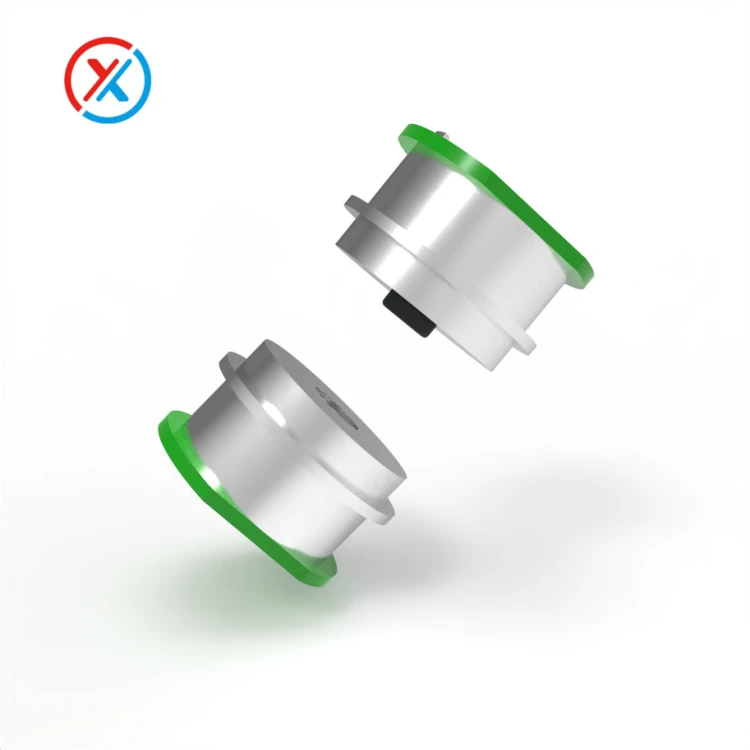
Retention also needs to suit the intended release action. Axial pull, sideways movement, and peeling separation can produce different results. A useful holding-force specification identifies the mating parts, gap, direction, and test arrangement.
For pogo pin assemblies, the magnets must maintain the intended position against the combined spring force, any compressed seals, and normal handling loads. Once mechanical stops establish the working height, increasing magnetic attraction does not necessarily increase contact pressure or reduce electrical resistance.
Temperature selection requires similar care. Neither material has one universal maximum operating temperature. The permitted conditions depend on the specific grade and magnetic circuit, while the actual exposure includes both temperature and time.
NdFeB grades differ in their resistance to irreversible magnetic loss. A grade suitable for normal operation may still require review if the magnet experiences heat during overmolding, adhesive curing, or nearby soldering.
Ferrite often offers useful high-temperature capability, but its performance should still be checked across the specified operating range. High- and low-temperature behaviour both belong in the material review where the application requires them.
The magnet rating also does not establish the allowable temperature of the complete connector. Plastics, adhesives, seals, coatings, and contact components may impose separate limits.
Where practical, installing magnets after a heating process can reduce their exposure. If magnets must remain in place during processing, representative assemblies should be evaluated using the actual thermal conditions.
Corrosion protection is another important difference. Ferrite is an oxide ceramic and generally resists corrosion well. That property does not protect adjacent steel parts, mounting features, or the electrical contacts.
NdFeB commonly relies on a protective coating, plating system, or encapsulation. Coverage, adhesion, edge condition, and damage during assembly affect that protection. An intact-looking outer housing does not establish that the magnet remains protected from moisture.
The finish on the pogo pins and the protection on the magnets are separate specifications. A connector described as having gold-plated contacts may use a different coating system on its magnetic components.
For humid, sweaty, or outdoor environments, evaluation should include the complete assembly. Moisture retention, housing joints, cable entries, cleaning exposure, and coating wear can influence performance. A waterproof claim and a corrosion-resistance claim need their own defined evidence.
Both magnet materials require suitable mechanical support. Ferrite and NdFeB can chip or crack under impact, excessive clamping, or concentrated assembly force. The housing should locate and retain the magnet without imposing uncontrolled stress.
Magnet pockets, adhesive allowances, seating surfaces, and edge protection should be included in the drawings. These features also help maintain the position that controls attraction and contact alignment.
Cost comparison should extend beyond the magnet purchase price. Ferrite's lower material cost may be offset by a larger housing or a revised mating arrangement. NdFeB may allow a smaller assembly but require additional protection and tighter handling controls.
The relevant comparison is between complete designs that meet the same functional requirements. Material price alone cannot establish which solution is more economical.
XINTENG supports drawing-based development of magnetic pogo pin connectors, including precision contacts, insulating carriers, housings, mating components, and cable assemblies. Magnet selection can be coordinated with contact travel, spring force, mounting geometry, and the intended attachment behaviour.
A useful development brief identifies the available volume, required retention, release direction, operating temperature, environmental exposure, and electrical functions. The selected magnet grade and protection requirements should then be linked to the approved assembly drawing.
Sample evaluation should check attachment and release, contact compression, alignment, and electrical performance. Where relevant, repeat those checks after temperature exposure, environmental testing, and mating cycles. This establishes whether the selected magnetic system remains suitable throughout the specified conditions.
1. Does NdFeB always provide a better connector design?
No. Its magnetic performance is useful in compact assemblies, but ferrite may meet the requirements where space is available and cost is important. Compare complete designs against the same retention, temperature, and environmental targets.
2. Does ferrite's corrosion resistance make the connector waterproof?
No. Water protection depends on the complete housing, seals, mounting joints, and cable entry. Ferrite's material properties do not establish the protection of the electrical contacts or surrounding components.
3. Will stronger magnets increase the connector's current capacity?
Not directly. Current capacity depends on the contacts, conductive path, terminations, and thermal conditions. Magnets help maintain the intended engagement, while contact pressure is primarily determined by spring compression and the mating geometry.
4. Can ferrite and NdFeB magnets be exchanged in an existing connector?
A substitution requires engineering review. Holding force, dimensions, magnetization, coating, mounting, and temperature behaviour may change. The revised assembly should be evaluated before treating the materials as interchangeable.


