


These figures describe a particular contact design and test procedure. They are not universal performance classes assigned to consumer, industrial, or other applications. A meaningful life rating must identify the working stroke, mating arrangement, environment, and acceptance criteria.
One cycle generally includes compression followed by release. The movement should follow the specified test stroke; it does not necessarily mean pressing the plunger to its maximum mechanical limit.
The installed working position matters because spring force, internal contact conditions, and wear change with compression. A rating established at one stroke should not automatically be applied to a different installation.
Mechanical life and electrical durability also need to be considered together. A pin may continue moving while its resistance has increased beyond the permitted limit. Conversely, a contact may still conduct while its return becomes sluggish or its remaining force becomes insufficient.
The end of useful life should therefore be defined by measurable requirements, such as contact resistance, continuity, spring force, plunger return, or permitted coating wear. "Still compresses" is not a complete durability criterion.
Several factors influence how quickly those characteristics change:
| Factor | Effect on service performance | What to control |
|---|---|---|
| Spring loading | Repeated or excessive compression can affect fatigue and force retention | Working stroke, preload, temperature, and spring design |
| Contact wear | Internal sliding and external mating can damage finishes or generate debris | Materials, plating, surface finish, and mating geometry |
| Alignment | Side loading or edge contact can produce localized wear and sticking | Guides, pad dimensions, mounting tolerances, and mechanical stops |
| Contamination | Dust and residues can interfere with movement and electrical contact | Assembly cleanliness, housing geometry, and maintenance access |
| Moisture and corrosion | Exposure can change resistance or obstruct movement | Material selection, coating quality, sealing, and environmental validation |
Spring material alone cannot establish a cycle-life rating. Wire dimensions, coil geometry, forming condition, working stress, and temperature all contribute to the result.
The operating pattern matters as well. A connector used in a frequently accessed charging dock experiences repeated movement. An internal module that remains compressed for long periods places greater emphasis on force retention under sustained loading. One test does not necessarily represent both conditions.
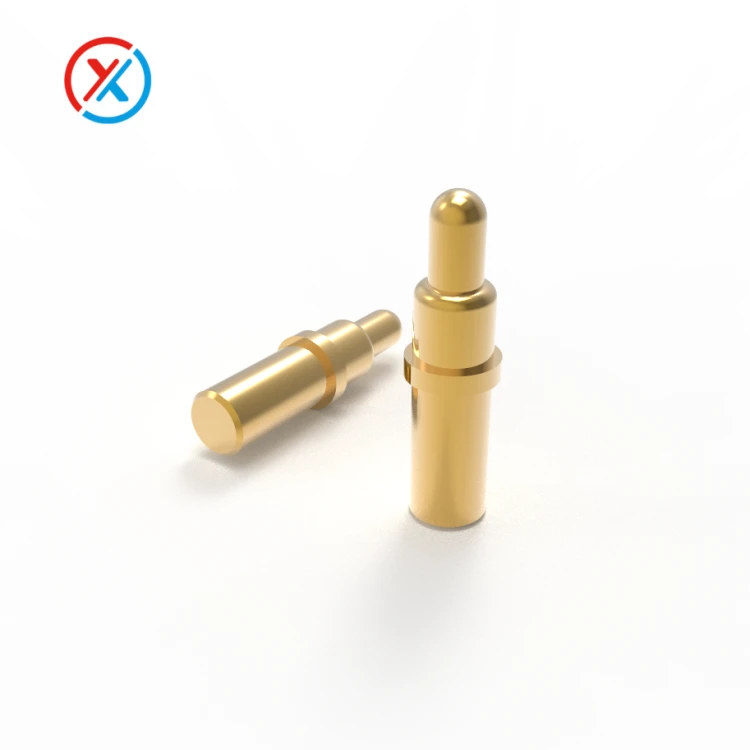
Wear occurs at more than the exposed tip. Inside a pogo pin, the plunger moves relative to the barrel. Bore finish, straightness, clearance, coating distribution, and cleanliness influence friction and return behaviour.
External mating conditions add another source of wear. A pin that meets the centre of a suitable pad can behave differently from one that repeatedly strikes an edge or slides sideways during engagement.
Mechanical support should keep these movements within the intended design. The housing or dock should guide engagement and carry structural loads, while stops prevent excessive compression. The contact should not be used as the final mechanical limit for the assembly.
Plating provides another part of the durability system. A suitable finish can help maintain a stable contact surface, but thickness alone does not determine life. Adhesion, hardness, coverage, underlayer support, and the mating material also matter.
Increasing spring force or gold thickness is therefore not a universal route to a longer-lasting pin. Either change may affect friction, mating load, dimensions, and cost. The complete contact system needs evaluation.
XINTENG supports drawing-based customization of pogo pin contacts, insulating carriers, housings, mating components, and cable assemblies. For a durability-focused project, contact geometry, spring force, working travel, materials, and surface finishes can be coordinated around the intended operating profile.
Prototype and small-batch evaluation can then establish whether the proposed construction meets the agreed life target. The target should remain linked to the tested configuration rather than being treated as an unrestricted claim.
A useful endurance report identifies:
The contact part number, revision, materials, and finishes.
Compression stroke and mating components.
Cycling rate, alignment, and environmental conditions.
Whether the contacts are energized and under what electrical load.
Inspection intervals and electrical or mechanical acceptance limits.
Sample quantity and individual results.
Electrical loading requires particular attention. Unpowered cycling does not establish durability during repeated energized connection and disconnection. Current, voltage, circuit behaviour, and switching conditions may introduce additional demands.
Resistance measurements after cycling should use consistent contact compression and measurement points. Where brief interruptions matter, monitoring during movement may be necessary because a final stationary measurement can miss them.
Cycle count can help establish a development requirement, but it is not a direct prediction of calendar life. For example, ten connections per day over 300 operating days each year produces a planning count of 15,000 cycles over five years.
That calculation estimates connection frequency only. Temperature, corrosion, contamination, sustained compression, and storage can affect performance independently of the number of mating operations. Any design margin should reflect the application and its uncertainty.
For procurement, request the conditions behind the stated life figure and compare them with the actual installation. A lower published rating tested under relevant conditions can be more informative than a larger number without a supporting procedure.
1. Is 100,000 cycles the standard life of every pogo pin?
No. It is a possible rating for a specific design under defined conditions. Other contacts may have lower or higher ratings. The test stroke, environment, electrical load, and acceptance limits are essential to interpreting the figure.
2. Does operating near maximum compression reduce life?
It can increase stress or overtravel risk, depending on the design. Use the manufacturer's specified working range. There is no universal compression percentage that guarantees optimum life for every pogo pin.
3. Can a cycle rating be converted directly into years of use?
No. Connection frequency provides a cycle-count estimate, but environmental exposure, sustained loading, and other aging mechanisms also affect service life. Calendar-life claims require application-relevant evidence.
4. Can a longer-life pogo pin be customized?
A custom design can address a higher durability target through geometry, materials, spring loading, finishes, and mating control. The resulting life must be confirmed through testing of representative assemblies against agreed criteria.


